

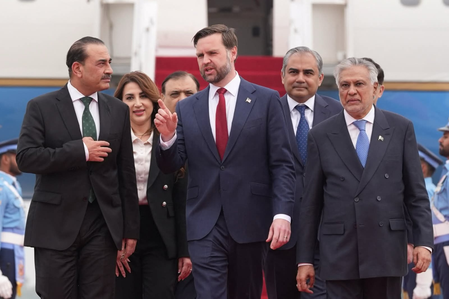
New Delhi, Aug 21 (IANS) With Pakistan’s National Assembly approving new legislation, army chief Asim Munir is soon to assume sweeping military powers as the head of a centralised command for the army, navy, and air force, thus giving him substantial authority over the country’s strategic decision-making, according to reports.
A leading UK newspaper had once termed the rise of now perhaps Pakistan’s singular most powerful person as “A king above all”, tracing his ascendence through times as a soldier-diplomat who has turned into the face of Islamabad’s international relations.
That was at the end of last year, when Pakistan’s Parliament hurriedly passed the 27th Amendment to its Constitution to expand the powers of the army chief, that stood legalised with Thursday’s approval.
Now Pakistan’s President needs to put his seal of approval once the Senate too passes the bills related to the military and nuclear command structure in continuation of last year’s 27th Constitutional Amendment. Of late, the Pakistani Army’s deeper role in governance, with Munir having expanded his role far beyond defence, has prompted speculations regarding him potentially becoming the country’s chief executive.
The former Director-General of Pakistan’s spy agency ISI, who became army chief, was conferred the rank of Field Marshal in May 2025. He was the second such officer to attain the rank after Ayub Khan, but the first Field Marshal to serve as the Chief of Army Staff simultaneously. What began as constitutional tinkering at the end of last year now appears designed to elevate him beyond the traditional role of an army chief.
Munir can hire, fire, retire, or extend service across all branches and be the principal military adviser to the Prime Minister on national security, defence, and all matters on the armed forces. He also gets decisive influence over nuclear and strategic command appointments. These measures go far beyond the traditional ambit of a Chief of Army Staff, placing Munir at the apex of both conventional and strategic military power.
This legislative consolidation has also coincided with Munir’s transformation into a diplomat. Traditionally, Pakistani generals have wielded influence in foreign policy, but Munir’s visibility on the international stage has been striking. His meetings with leaders such as US President Donald Trump, President Xi Jinping in Beijing, also being seen leading a truce delegation to Iran, as well as his presence at regional security forums, all suggest that he is positioning himself as Pakistan’s chief interlocutor with the world.
Elsewhere, such exercises are usually led by Foreign Ministers and Prime Ministers.
Munir’s dual role as military commander and diplomatic envoy underscores the powers he now wields and the willingness of the state to that extent. Back home, he is seen as the man behind the incarceration of Imran Khan over a feud that is said to have begun in 2019 when Munir, then a Lt General, was removed as the ISI chief when the former was Prime Minister. Munir’s accumulation of authority through constitutional amendments and parliamentary bills mirrors the methods of past military rulers, though with a difference.
Ayub Khan in 1958, Zia-ul-Haq in 1977, and Pervez Musharraf in 1999 – all seized power through coups, suspending constitutions and imposing martial law. Munir appears to have acquired power through legislation passed by civilian institutions.
In earlier instances, Ayub Khan capitalised on political instability and weak civilian governance, Zia exploited polarisation and mass protests against Zulfiqar Ali Bhutto, while Musharraf intervened amid an economic crisis and Nawaz Sharif’s dismissal. Pakistan is again facing crushing debt, political division, and a civilian leadership struggling to assert itself. And like the past, the military has stepped in to fill the vacuum. The difference is that instead of tanks, bills in Parliament are doing that job. The method thus distinguishes him, where his rise in power is through Parliamentary procedures. This strategy not only shields him from accusations of illegality but also ensures that his power is supported by the state’s legal framework. This consolidation of power has stoked speculations of a possible transition into a system where the military rules through constitutional mechanisms, leaving civilian leaders as figureheads. Whether Munir becomes the formal ruler or continues to rule from the garrison town of Rawalpindi is for later. For now, his sweeping powers already make him the most dominant figure in Pakistan’s political landscape.
–IANS
jb/vd