

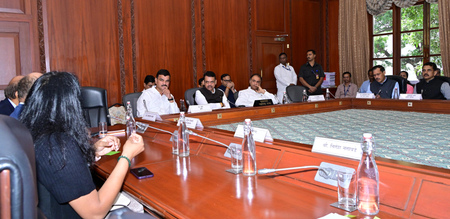
Mumbai, Aug 21 (IANS) In a major push to integrate modern technology into agriculture, Maharashtra Chief Minister Devendra Fadnavis on Friday directed the Agriculture Department to implement a pilot project on Artificial Intelligence (AI) and ‘Digital Twin Learning’ across the state.
The initiative aims to enhance crop yields using advanced tools, including satellite technology, drones, IoT sensors, and data analytics.
In its initial phase, 10,000 farmers will be selected for the trial.
The decision was announced during a presentation on the AI and Digital Twin Learning project held here.
Key crops targeted in this phase include cotton, soybean, pigeon pea (tur), sugarcane, orange, turmeric, onion, and maize.
Speaking at the meeting, CM Fadnavis said that the Agricultural Development Trust at Baramati developed the initiative to address climate change, water scarcity, declining soil fertility, and rising production costs.
He emphasised creating a unified digital system by collecting multi-source data on crop growth, water requirements, soil moisture, weather conditions, and pest outbreaks.
Analysing this data via machine learning will allow the state to deliver tailored crop advice to individual farmers, reducing input costs and increasing overall farm income, the Chief Minister added.
State Agriculture Minister Dattatray Bharane highlighted that AI-based farming is a priority for the state government and expressed confidence that the project will bring transformative growth to Maharashtra’s agricultural sector.
Pratap Pawar, Chairman of Sakal Media Group, hailed the state government’s backing, noting that state support is essential for scaling such impactful development initiatives.
Nilesh Nalawade, CEO of the Agricultural Development Trust, presented the pilot results.
Early trials on sugarcane farming yielded significant improvements.
He informed that average production increased from 65.45 tons per acre to 73.12 tons per acre—an average increase of 17.66 tons per acre.
“AI-driven irrigation management resulted in an average water savings of 42 per cent, conserving around 90,000 litres of water per hectare daily. Drone imagery analysed through AI enables early detection of crop diseases, sending actionable irrigation and spraying updates directly to farmers’ mobile phones,” he noted.
With more than 10,000 farmers already experiencing positive outcomes from the initial trials, the state plans to evaluate region-wise and crop-wise performance before expanding the model statewide, the government statement said.
–IANS
sj/khz