
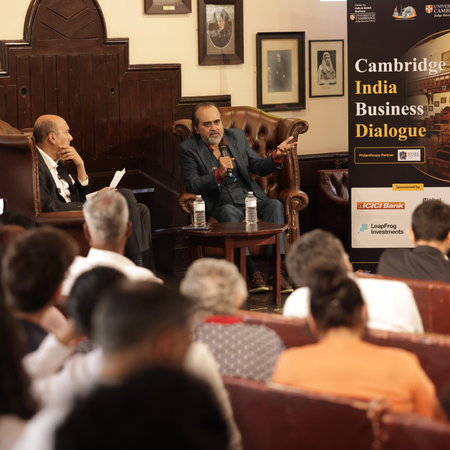
New Delhi, May 31 (IANS) Philosopher and author Acharya Prashant addressed a packed audience at the University of Cambridge on Friday in a fireside chat at the historic Cambridge Union, arguing that humanity’s gravest crises, climate change foremost among them, cannot be resolved by technology or policy alone because their root lies not in the external world but in the unexamined inner life of human beings. The audience response was overwhelming; seats were fully booked even before the day arrived.
The Cambridge Union, which has hosted figures including Winston Churchill, Franklin D. Roosevelt, and Stephen Hawking, served as the venue for what organisers described as the summit’s marquee session. Among an exceptional roster of distinguished speakers drawn from politics, diplomacy, and industry, Acharya Prashant was the sole philosopher on the programme and was accorded the longest speaking slot of the day, a distinction that underscored the organisers’ intent to place questions of inner life at the centre of a gathering otherwise defined by external power.
The event was hosted by the Cambridge India Business Dialogue and conducted by Professor Jaideep Prabhu, Director of the Centre for India and Global Business at Cambridge Judge Business School, one of the world’s leading institutions for business and global affairs research, who led the fireside conversation and posed questions to Acharya Prashant throughout. The theme of the conversation was ‘Indian Contemplative Traditions as Applied to Climate Change, Inequality, and Global Responsibility’. The gathering included Kanishka Narayan, Minister for AI and Online Safety and Member of Parliament for Vale of Glamorgan; Lord Karan Bilimoria; India’s High Commissioner to the United Kingdom, H.E. Periasamy Kumaran; and Nyrika Holkar of the Godrej Enterprises Group. Notably, Acharya Prashant was the only speaker at the summit whose session was moderated by a University of Cambridge professor.
The IIT Delhi and IIM Ahmedabad alumnus, who founded the PrashantAdvait Foundation, told the gathering that humanity had never been more prosperous or more powerful, and had also never been more unable to stop. “Outwardly, we are more advanced than at any point in history,” he said. “Inwardly, we are still cavemen.”
The argument he developed was precise. Human desire, he said, is not a technical problem and cannot be resolved by technical means. Formal education, across schools, universities, and institutions, trains people in skills and external knowledge but does not address the education of the self. The questions that most determine how knowledge will be used are almost never asked: what is desire, where do our wants come from, why do we want what we want, and does the self exist as we imagine it? He was unambiguous that he deeply respects science and that technology is necessary and valuable. The problem, he said, is not science itself but the unexamined self that directs it. Every tool humanity has built has been turned toward feeding a psychological emptiness that remains unexamined and therefore insatiable. Even if the entire planet were to be exploited in this effort, he said, the inner hunger would remain.
On climate specifically, he argued that the crisis is being persistently misread. Efficiency, he observed, has never historically reduced consumption. Steam engines improved; electricity use multiplied many times over. Electric vehicles are now positioned as the answer, yet they require cobalt and lithium to be mined, forests to be cleared, and ecosystems to be disturbed. Leaders are shaped not only by voters but by consumers, and the consumer is the same self that no policy has yet touched. As long as that self remains unchanged, workarounds will be found for every measure that inconveniences the habit of wanting more.
When Professor Prabhu raised the question of whether there was time left for the kind of transformation being described, Acharya Prashant was unequivocal. Time, he said, is needed only when there is a distance to cover or an additional task to accomplish. The climate crisis does not require humanity to do something additional. It requires humanity to cease what it is already doing. “Acceleration takes time”, he said. “How much time does it take to stop where you are?” Successive global climate conferences have failed, he argued, for one shared reason: each has assumed the solution demands more action, when the crisis is itself the product of too much.
Responding to a question on bridging Eastern and Western, masculine and feminine, and economic worldviews, he turned the premise around. Who exactly crosses the bridge, he asked, and does the crossing change anything? A person can walk to the other side and remain inwardly identical. Inner honesty, he said, is the only thing that actually matters in any such crossing. He drew on the Upanishadic distinction between ‘Vidya’ and ‘Avidya’, outward knowledge and inward wisdom, calling it the oldest available diagnosis of the imbalance modern civilisation has only deepened. Humanity has progressed immensely in external knowledge, he said, but inward understanding remains almost entirely absent.
Asked by Professor Prabhu why he had walked away from a corporate path after IIT Delhi and IIM Ahmedabad, he described the decision as a gradual recognition rather than a sudden break. The problems he was positioned to address in technology and management were downstream of something far more fundamental that society was barely registering. Many who competed alongside him, people of exceptional talent and ability, went on to deploy that talent in ways that accelerated the very crises now demanding urgent solutions. The upstream problem, he said, is one of human interiority.
That recognition shapes the work he now runs. Through the PrashantAdvait Foundation, Acharya Prashant conducts an online night school every day of the month, in which students examine their lives through the Upanishads, the Bhagavad Gita, Buddhist teachings, the writings of Lao Tzu, and existential literature and plays. Students take examinations; the programme reaches across more than 100 countries. The purpose, he said, is not scholarship. “We are students of the self,” he told the gathering. “These works are not the destination. They bring us back to ourselves.”
Speaking to the media after the session, Acharya Prashant sharpened the message he had carried into the Cambridge Union. In the last two hundred years, he said, humanity has successfully tried science, technology, economic growth, and exploration, and has made enormous advances in all of them. Yet it continues to move toward war, ecological crisis, and inner dissatisfaction. The one thing it has not seriously attempted is “mass education of the self”. The questions that remain unasked at scale — who am I, what do I truly want, will accumulation ever satisfy me — are precisely the questions whose answers would change everything. The solution, he said, lies in inner honesty, love, and right intent. Outer progress without inner understanding is not progress; it is acceleration toward a cliff.
On what Indian contemplative traditions offer to economics and business specifically, he was direct. The problem, he said, is not the system. Science, economics, business, and medicine all ultimately aim at human welfare. But human welfare cannot be achieved without understanding the human being at the centre of every system. If the chooser is confused, the system becomes destructive. If the inventor lacksƒp wisdom, the invention causes harm.
Technology and policy are only as good as the inner clarity of the person deploying them. The root of global problems, he said, is inward. Better systems require wiser human beings.
On whether technology can solve climate change and the intensifying heat crisis, his answer was unambiguous. Climate change, he said, is not only a carbon problem but a human psychology problem. The fire producing the emissions is human ego, greed, and unexamined desire. Without inner change, technology will not solve the crisis. It will accelerate it.
Acharya Prashant is a philosopher and author of multiple bestselling books who is currently on a UK tour. After Cambridge, he will be speaking at Oxford, the London School of Economics, King’s College London, and other prominent institutions. Drawing on the Upanishads, the Bhagavad Gita, Madhyamika Buddhism, and global wisdom literature, his work reaches over 100 million online followers across more than 100 countries.
–IANS
dpb/