
Seoul, Oct 21 (IANS) The top US military commander in South Korea on Wednesday called for conducting more spread-out combined exercises between the allies throughout the year, rather than relying on the current biannual drills, citing the need to better adapt to an evolving security environment.
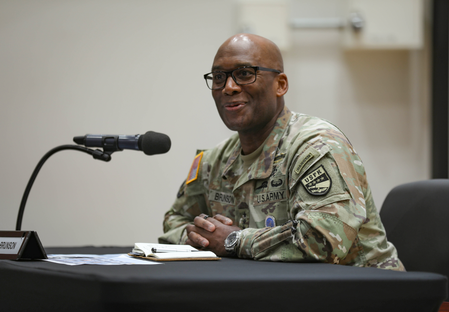
US Forces Korea (USFK) Commander General Xavier Brunson made the remarks during a dialogue session in Seoul, saying he met with the South’s Joint Chiefs of Staff (JCS) Chairman General Jin Yong-sung earlier this week to discuss their next springtime drills.
“I just had a meeting this week with General Jin, and we talked about how we might train in the upcoming Freedom Shield (FS) exercise,” Brunson said during the event hosted by the American Chamber of Commerce in Korea (AMCHAM).
“And what one of the things that we discovered is that we can’t hinge our readiness on two exercises a year. It has got to be training throughout the entirety of the year, where we continue to shape ourselves to meet the objectives set forward for us by our national command authorities,” he said, Yonhap News Agency reported.
“We have to understand that as the environment changes and new challenges arise, we’ve got to train, rehearse to meet those challenges,” the commander said.
Brunson made similar remarks at a forum in Washington last week, suggesting the drills take place in a more “distributed fashion” and “in between” those two regular exercises.
South Korea and the United States hold two major large-scale combined exercises every year — the FS in spring and the Ulchi Freedom Shield (UFS) in summer — to primarily train for contingencies against North Korea.
The previous UFS exercise in August was cut in half following orders from U.S. President Donald Trump, who cited cost concerns and sought a conciliatory gesture toward Pyongyang amid renewed interest in resuming talks with North Korean leader Kim Jong-un.
Turning to industrial cooperation, Brunson highlighted the “regional sustainment hub” concept, which he described as vital to deepening the alliance partnership in maintenance, repair and overhaul (MRO) operations.
The concept centres on leveraging South Korea’s defence manufacturing sector to maintain and repair U.S. military hardware in Korea, rather than shipping it back to the U.S. Brunson has described the idea as creating a “depot-like forward” on the Korean Peninsula.
“What if we could move that across domains?” he said. “Sustaining is a key component to any deterrence that you might achieve because if we don’t have to send things back to the United States for repair, for overhaul, for parts, and we are able to keep those things in theatre, then what we’ve demonstrated is endurance.”
–IANS
akl/