

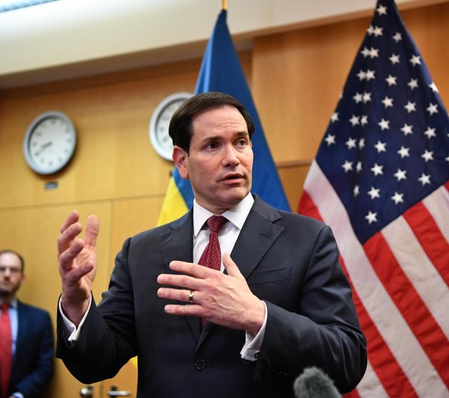
Washington, July 17 (IANS) The Trump administration announced a new visa restriction policy targeting foreign nationals linked to far-left terrorist and aligned groups, as Secretary of State Marco Rubio opened a ministerial with representatives from more than 60 countries to coordinate efforts against what he described as the resurgence of transnational political terrorism.
The new policy will restrict entry into the United States of foreign nationals who have “supported or incited acts of terrorism; supported violent criminal activity; participated in economic sabotage; financed, recruited, or provided logistical support for violent or criminal actions committed by Far-Left Terrorist and other aligned groups; and/or facilitated the convergence of Far-Left Terrorist and other aligned networks for the purposes of violent action,” according to a statement issued by the State Department.
Rubio said the visa restrictions were aimed at “safeguard[ing] the American homeland by restricting entry of foreign nationals who finance, recruit, incite, or otherwise enable terrorist, violent, and criminal Far-Left Terrorist networks – closing the visa pathways that Far-Left Terrorists and other aligned groups exploit to threaten American lives, undermine economic stability, and coordinate violent action on US soil.” The measures are being taken under Section 212(a)(3)(C) of the Immigration and Nationality Act.
The visa announcement came as the State Department hosted the Ministerial on the Resurgence of Political Terrorism, bringing together governments from the Western Hemisphere, Europe and Asia to expand coordination, strengthen information sharing and enhance international law enforcement cooperation against what the administration described as a growing transnational threat.
Opening the conference, Rubio said protecting citizens remained “the first responsibility” of every government and argued that counterterrorism strategies should now address what he called a resurgence of politically motivated violence from the far left.
“For far too long, however, our counterterrorism doctrine has had a blind spot – a blind spot when it comes to extremist violence from the political left,” Rubio said. He added, “We can – and we must – identify and map this threat and rebuild our counterterrorism architecture to defeat it.”
Rubio said the United States had already designated four violent far-left groups as Foreign Terrorist Organizations and announced Rewards for Justice offers of up to $10 million for information disrupting their financing. “There will be more designations soon,” he said, adding that Washington was working with partner governments to strengthen intelligence sharing, law enforcement cooperation and financial disruption of transnational extremist networks.
White House Deputy Chief of Staff Stephen Miller said President Donald Trump’s National Security Presidential Memorandum-7 had, for the first time, directed all U.S. law enforcement and intelligence agencies “to work together to disrupt, identify, defund, debank, arrest, and prosecute these political terrorists.”
Treasury Secretary Scott Bessent said the Treasury Department would deploy financial sanctions and anti-money laundering tools to target funding networks supporting political terrorism while acting on “suspected unlawful conduct” rather than political beliefs.
According to a State Department fact sheet, the administration believes far-left anti-government terrorism now accounts for more attacks and plots in the United States than any other ideological category. It said governments participating in the ministerial would work to improve information sharing, restrict terrorist travel and strengthen international cooperation against transnational extremist networks.
The latest initiative reflects the Trump administration’s broader emphasis on combating politically motivated violence through immigration enforcement, law enforcement cooperation and financial measures. The ministerial marks the administration’s latest effort to build an international coalition around that strategy while encouraging partner countries to deepen intelligence sharing and counterterrorism coordination.
–IANS
lkj/rs