

Washington, May 17 (IANS) In the immediate aftermath of President Donald Trump’s historic trip to Beijing, the Trump administration on Sunday signalled a new phase in US-China trade and economic ties, outlining a more structured trade relationship with Beijing while maintaining tariffs and restrictions on sensitive sectors, in remarks closely watched by global markets and trading partners, including India.
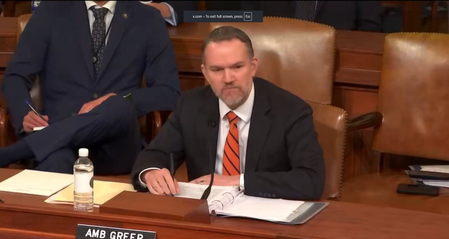
US Trade Representative Jamieson Greer said the administration was moving toward a formalised mechanism to manage trade disputes and economic engagement with China after President Donald Trump returned from a high-profile summit with Chinese President Xi Jinping in Beijing. Greer spoke separately on CBS News’ “Face the Nation” and ABC News’ “This Week”.
“We’re focused on trade in non-sensitive goods,” Greer said on CBS’s “Face the Nation,” adding that the administration wanted structured engagement with China on products such as agricultural goods, Boeing aircraft, medical devices and consumer items.
Greer said Washington and Beijing had agreed to establish a “Board of Trade” and a “Board of Investment” to handle economic disputes and stabilise relations between the world’s two largest economies. He described the move as an attempt to replace the “ad hoc approach” that had previously defined bilateral trade ties.
The comments came amid continuing uncertainty over tariffs, supply chains and strategic competition between the two countries.
While Trump told reporters after the summit that tariffs “didn’t come up,” Greer said on ABC’s “This Week” that trade discussions had already been handled at lower levels before the leaders met.
“The Chinese know… we’re going to have a certain level of tariff to control our imports,” Greer said on CBS’s “Face the Nation,” while adding that Washington expected greater market access from Beijing.
Greer said China had already moved to restore access for some American exports, including beef and poultry facilities that had previously been deregistered. He also pointed to ongoing Chinese purchases of American soybeans and Boeing aircraft.
The administration, however, offered few concrete details on several headline announcements from the Trump-Xi summit.
Greer confirmed on CBS that China had agreed to purchase 200 Boeing aircraft initially, with the possibility of larger future orders. But he acknowledged that final details on several agreements were still being prepared.
The summit also took place against the backdrop of rising global concern over the Iran conflict and instability around the Strait of Hormuz, a critical route for oil shipments.
Greer said on ABC’s “This Week” that Trump’s discussions with Xi included the need to keep the Strait of Hormuz open and ensure China did not provide material support to Iran.
“The President was very focused on making sure that they didn’t provide material support to Iran,” Greer said.
For India, the evolving US-China trade posture could carry significant implications. American efforts to reduce dependence on Chinese manufacturing and sensitive technologies have already pushed multinational firms to diversify supply chains towards countries such as India and Vietnam.
–IANS
lkj/ksk/uk