

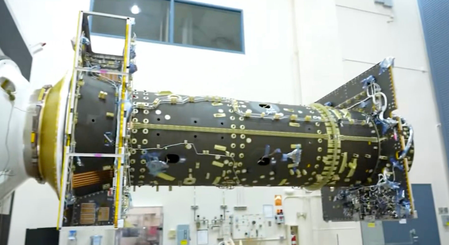
Washington, Oct 8 (IANS) NASA and the US Department of Energy have signed an agreement to accelerate the development of nuclear-powered spacecraft and lunar infrastructure, including plans for a space reactor mission in 2028 and a nuclear power system to support a future American base on the Moon.
The agreement, signed Thursday in Washington, brings the two agencies together on nuclear fuel development, advanced research, testing, launch integration and operations as the United States seeks to expand its presence in deep space.
NASA Administrator Jared Isaacman and Energy Secretary Chris Wright signed the memorandum of understanding, titled “Accelerating American Leadership in Space Nuclear Power and Propulsion,” during the Golden Age Summit at the Donald J. Trump Institute of Peace.
The agreement will take effect November 1.
“We are entering the ‘Nuclear NASA-era,’ which represents a major transformation for space exploration,” Isaacman said.
“Nuclear power will allow us to go farther, operate longer, and field more capable spacecraft and instruments than ever before.”
He said the work would lay the foundation for future fission-powered spacecraft and expand opportunities for scientific exploration.
The agreement establishes a framework for cooperation between NASA and the Energy Department across the development of space nuclear technologies, from fuel production to operational deployment.
The agencies said safety would remain central to the programme.
NASA plans to launch Space Reactor-1 Freedom in 2028, a mission intended to move nuclear-powered space technology from laboratory development towards operational use in deep space.
The mission is expected to support the development of Lunar Reactor-1, a fission-based surface power system designed to provide electricity for a future Moon base.
Unlike solar power, a nuclear reactor could operate through prolonged periods of darkness and in permanently shadowed regions of the lunar surface.
NASA said nuclear power would be needed to support habitats, communications systems, scientific instruments, rovers and other infrastructure required for sustained human activity on the Moon.
Such systems could also support future missions to Mars, where spacecraft and surface operations would face demanding energy requirements.
US President Trump signed an executive order in December 2025 directing NASA to develop a launch-ready lunar surface reactor by 2030.
The latest agreement strengthens cooperation between the agencies as they work towards that target.
“Thanks to President Trump, America’s nuclear renaissance is reaching a new frontier,” Wright said.
“The Energy Department is proud to partner with NASA as we help American space missions reach uncharted territory.”
NASA said the two reactor programmes would also help establish an American industrial base capable of developing and supplying nuclear technologies for space exploration.
The agencies are continuing work on radioisotope power systems, which use heat generated by radioactive decay to provide electricity or maintain equipment temperatures.
NASA’s Dragonfly mission to Saturn’s moon Titan, scheduled for launch in 2028, will use a radioisotope thermoelectric generator and 24 lightweight heater units to power and warm the spacecraft.
The mission will investigate Titan’s environment and its potential habitability.
NASA and the Energy Department also plan to support the European Space Agency’s Rosalind Franklin Mars rover by providing 24 radioisotope heater units to protect scientific instruments from extreme cold.
NASA has used nuclear power systems for decades on missions where solar energy is insufficient or impractical, including exploration of the outer solar system.
–IANS
lkj/ksk/dan