

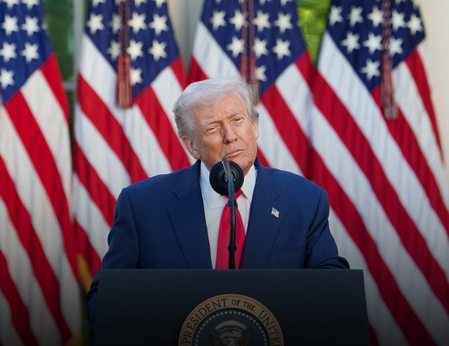
Washington, July 25 (IANS) President Donald Trump on announced that four privately funded advanced reactors had reached critical milestones under an administration-backed programme aimed at accelerating nuclear innovation.
Speaking at the White House alongside senior administration officials and executives from four nuclear technology companies, Trump said the achievement marked the beginning of a new era for the US nuclear industry after decades of decline.
“America is building again. America is dreaming again, and we’re leading the world in pioneering the next generation of nuclear power and there’s nobody even close,” Trump said.
He said the administration had exceeded a goal he set through four executive orders signed last year to revive America’s civilian nuclear sector.
“As part of this effort, I directed Secretary of Energy Chris Wright to establish a pilot programme for advanced reactors and see at least three cutting-edge reactors started up safely by the Fourth of July,” Trump said.
“What we’ve done has been pretty much of a miracle.”
Trump said the United States had gone more than four decades without privately funded advanced reactors reaching operation.
“These are the first new privately funded advanced reactors to turn on in the United States in over four decades,” he said.
He also criticised the regulatory process that had previously slowed nuclear development.
“In the past, it often took six years or more to approve a reactor design if they were ever approved at all.”
Director of the Office of Science and Technology Policy Michael Kratsios said the administration had surpassed its original target.
“The last time that a privately funded new reactor design went critical was in 1974,” Kratsios said.
“So it was over 50 years ago, and we were able to achieve that and surpass it by having four.”
Kratsios argued that the achievement signalled America’s return as a global leader in both conventional and advanced nuclear technology.
“President Trump said, enough of that. America is going to be back as the leader in the nuclear space.”
Executives whose companies participated in the programme credited the administration’s executive orders with accelerating development.
A representative of Antares Nuclear said the company’s reactors could eventually support military installations and future space missions.
“We look forward to being a resilient energy source for Golden Dome to power high-powered assets in space and eventually undersea autonomy,” he said.
He added that the company planned to deploy reactors on US military installations before 2028.
Another executive said the United States had shifted its focus from presentations to production.
“Over the last 30 years, we became more interested in PowerPoint than in power plants, and it’s your leadership that is changing that,” he said.
A third company executive described the moment as historic.
“I do think people are going to look back and believe that this is when the tide turned on nuclear and how we unlocked cheap and abundant energy.”
One executive revealed that his company’s reactor reached criticality only minutes after midnight on the Fourth of July.
“We cut it close, but we went critical at 12:20 a.m. on the Fourth of July.”
He also announced plans to raise $1 billion this year and move into a one-million-square-foot manufacturing facility.
“Our target market is data centres, so we’re making the ideal nuclear product to power the data centres with bring your own power.”
Energy Secretary Chris Wright said the administration’s broader energy strategy had already transformed the country’s energy position.
“Today we have the lowest priced, most secure energy of any country in the world.”
Interior Secretary Doug Burgum described nuclear power as central to the administration’s “energy dominance” agenda and argued that private investment, rather than government subsidies, was driving the industry’s revival.
“President Trump understands innovation is the source of American greatness. You get rid of the regulation, you support entrepreneurs, the capital flows, America wins.”
The United States pioneered commercial nuclear technology during the 1950s and for decades maintained the world’s largest fleet of nuclear reactors. However, high construction costs, lengthy licensing procedures and public opposition slowed new reactor development, while Russia and China expanded their nuclear industries at home and overseas.
–IANS
lkj/rs