
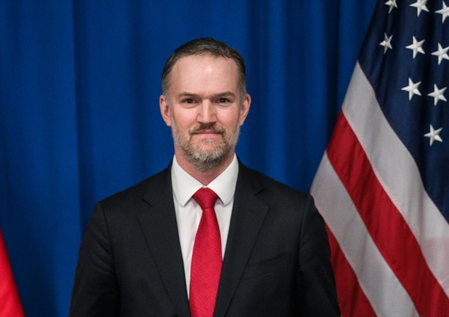
Washington, Feb 23 (IANS) US Trade Representative Jamieson Greer said the Trump administration has “very durable tools” to keep its tariff-driven trade strategy intact after the Supreme Court struck down most of President Donald Trump’s sweeping tariffs, insisting the White House is now focused on “continuity” as it shifts to other legal authorities and investigations.
In an interview to a top US media portal on Sunday, Greer said the Trump administration had prepared “backup plans” in case the earlier authority was removed.
“We found ways to really reconstruct what we’re doing,” he said, adding: “Now, it doesn’t have the same flexibility that the US President had under the previous authority that he was using, but it gives us very durable tools.”
Greer said the core approach remains unchanged.
“The policy hasn’t changed,” he added.
“The legal tool to implement it, that might change, but the policy hasn’t changed. And so, we’re aiming for continuity.”
Pressed on why President Trump did not use those tools from the start, Greer said the initial move was driven by speed.
“It mostly had to do with needing to act very quickly,” the US Trade Representative said, calling the earlier statute “an emergency statute” selected amid what he described as “the huge expanse — in the trade deficit, a 40 per cent expansion under former US President Biden.”
He said the Trump administration now intends to rebuild its tariff architecture through other statutes.
“We can reconstruct our half of the deal with Section 301, Section 232,” Greer added, describing them as “other tariff authorities with clear designations of authority that we can put in place and keep for as long as needed to resolve the problems that we discover.”
He said the shift will include a mix of new investigations and existing measures.
The US Trade Representative added that he would be “conducting Section 301 investigations”, while noting the Commerce Department has tariffs already in place under Section 232.
“A lot of tariffs are still in place,” he said, adding that “business understands this is the — you know, this is the direction we’ve been going. We’re going to continue going this way.”
On how the Trump administration defines “national security” when considering tariffs, Greer cast the concept broadly.
“Anything involving manufacturing, frankly, can have — can really feed into the ecosystem… we need to have security,” he said, citing lessons from the Covid-19 pandemic and the need for supply chains that support hospitals and the military.
Greer identified ongoing and planned investigative targets.
“We have open Section 301 investigations of Brazil and China,” he said.
He also pointed to future action tied to “industrial excess capacity”, saying it would cover “a lot of these countries in Asia that have overcapacity”.
Greer said the US administration is also “looking at unfair trading practices”, including “rice overseas”, adding that subsidies “kill our rice farmers here”.
He sought to downplay the impact of the court decision on Trump’s planned meeting with the Chinese President Xi Jinping, saying the global tariff now in place “doesn’t single out any country”.
“Going into this meeting, the purpose of the meeting with President Xi, it’s not to — it’s not to fight about trade,” Greer said.
Instead, the US Trade Representative said it was to “make sure that the Chinese are holding up their end of our deal”, including “buying American, you know, agricultural products and Boeings and other things”, and “making sure they’re sending us the rare earth that we need”.
When asked whether past tariff collections would be refunded, Greer said the US administration is awaiting further court direction.
“We need the court to tell us what to do,” he said, adding that the ruling “gave zero guidance on this”.
Greer did not mention India in the interview.
However, his emphasis that the US administration is pursuing “continuity”, including a “15 per cent tariff” that he said “applies globally” and “doesn’t single out any country”, signals that India — like other trading partners — would be covered by the across-the-board tariff framework discussed on the programme, even as the Trump administration pivots to Section 301 and Section 232 tools and wider investigations.
–IANS
lkj/khz