
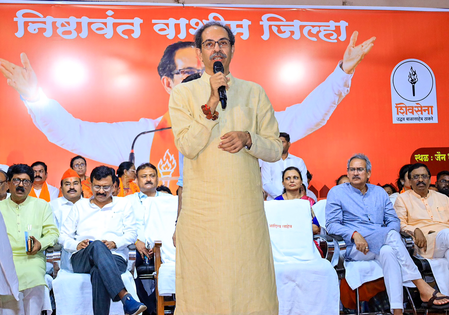
Mumbai, June 29 (IANS) The three-day tour by Shiv Sena (Uddhav Balasaheb Thackeray) chief Uddhav Thackeray in the constituencies represented by the rebel MPs was planned after the faction led by Maharashtra deputy Chief Minister and Shiv Sena chief Eknath Shinde launched ‘Operation Tiger’ to lure six Shiv Sena (UBT) MPs into its fold.
The Shinde faction also announced plans for ‘Split 3.0’, aimed at engineering defections among Shiv Sena (UBT) MLAs and corporators in Maharashtra. Against this backdrop, Thackeray’s outreach was intended to reassure party workers that while the party may have suffered setbacks, it was far from defeated.
However, the turbulence surrounding Shiv Sena (UBT) indicates that preventing a “Split 3.0” will be an uphill battle for Uddhav Thackeray. Following the massive vertical split led by Shinde in 2022 and the subsequent ‘Operation Tiger’, the party lost six of its nine MPs to the Shinde faction. A significant number of Shiv Sena (UBT) MLAs are also reportedly looking to switch sides to the Shinde camp.
Thackeray’s ability to survive this third wave depends on his capacity to revive the party by reaching out directly to the sainiks (grassroots workers) and the public. His success, however, will depend on shifting his political strategy from defensive crisis management to structural reform while striking a delicate balance between emotional appeal, organisational survival, and political realities.
The Shiv Sena (UBT) chief’s primary political currency since the 2022 split has been public sympathy, with Uddhav Thackeray projecting himself as a leader betrayed by trusted aides. However, the rebel MPs, including Omprakash Raje Nimbalkar and Nagesh Patil-Ashtikar, have sought to replace that narrative with one centred on “constituency survival.” They argued that remaining in the Opposition deprived their constituencies of development funds, claiming that the Rs 5 crore MPLADS allocation is inadequate without the backing of the state government.
While the grassroots sainiks are often driven by emotional loyalty to the Thackeray surname, the broader electorate is transactional. If Shinde effectively frames the Uddhav Sena faction as an “obstacle to development,” Thackeray’s focus on emotional betrayal risks losing its edge on neutral voters who prioritise local infrastructure and state aid.
Historically, the Shiv Sena has been a bottom-up organisation driven by local shakhas (branch offices). This structure is both Thackeray’s greatest asset and a major vulnerability. His core strategy involves bypassing top-tier leaders and appealing directly to local cadres. He has consistently argued that “leaders can be bought, but the loyal worker cannot.” However, a recurring issue highlighted by the departing MPs is the gatekeeping by senior Shiv Sena (UBT) leaders like Sanjay Raut. Rebel MPs openly criticised the “harsh language” and structural mistrust within the inner circle.
For successfully retaining the sainiks, Thackeray must democratise access to himself and ensure that local office-bearers feel heard rather than managed by a central command. He needs to transition from a remote figurehead to an active, collaborative manager. The Sena (UBT)’s current structure heavily concentrates decision-making power within a small, Mumbai-centric circle.
Ground-level leaders and regional MPs feel alienated from top-tier strategies. Thackeray needs to institutionalise a broader governing council that gives regional leaders from Marathwada, Vidarbha, and North Maharashtra a real voice in assembly poll ticket distribution and coalition seat-sharing talks.
Thackeray’s strongest asset remains the emotional capital associated with the “Thackeray” name among the core Shiv Sainiks. Drawing on that sentiment, his recent offer to step down if party workers believed the rebels’ allegations was a classic example of his emotional appeal to the cadre.
To translate public outreach into actual electoral recovery, the Shiv Sena (UBT) leadership needs a strategic pivot. In civic campaigns, the slogan “Ek Hai Toh Safe Hain” and appeals to the Marathi manoos identity faced severe headwinds against Mahayuti’s development blitz. The Sena-UBT chief needs an economic and governance alternative—focusing heavily on industrial flight, youth unemployment, and agrarian distress – rather than relying solely on identity politics.
Former state minister and son Aaditya Thackeray’s aggressive focus on governance, climate, urban infrastructure, and farmer welfare represents the party’s best bridge to younger voters. Giving younger, aggressive grassroots leaders a bigger platform will counter the perception that the party is shrinking into a legacy club.
Since Lok Sabha dynamics often hinge on national narratives, Thackeray’s best bet for revival lies in hyper-local state assembly constituencies where individual candidate relationships and historical shakha loyalty still outweigh the monetary resources of the ruling front.
Reaching out to the people will keep the party alive as an emotional force, but converting that into a political revival tool requires structural reform. If Thackeray cannot fix the internal communication gaps that alienate his senior lawmakers, emotional appeals to the public may not be enough to stop the institutional bleeding.
Thackeray faces an acid test of converting the emotional sentiment into ground-level pressure. By mobilising local party workers to protest outside the offices of wavering MLAs and MPs, he can raise the political cost of defection, making leaders realise that leaving the Thackeray brand might mean losing their actual voter base in the upcoming local and state elections.
While emotional appeals may help Thackeray reassure his party faithful, his ability to retain elected representatives will depend on addressing their concerns over political survival, access to resources, and prospects. If he cannot convince his legislators that they can retain their seats under the Shiv Sena (UBT) banner without the backing of the ruling machinery, his efforts at structural containment are likely to fail.
(Sanjay Jog can be contacted at sanjay.j@ians.in)
–IANS
sj/snj/skp