

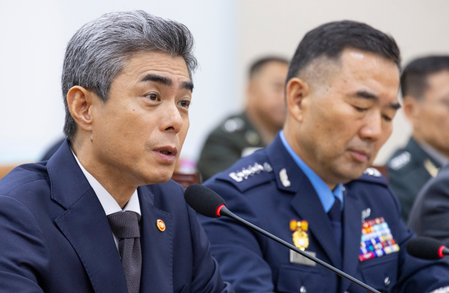
Seoul, Oct 26 (IANS) South Korea and the United States are closely coordinating on setting a target year for Seoul’s retaking of wartime Operational Control (OPCON) from Washington, Defence Minister Kang Shin-chul said Monday.
His remarks came after US Forces Korea (USFK) Commander Gen. Xavier Brunson’s recent comments that “conditions have changed” for South Korea to retake OPCON have drawn pushback from Seoul.
“The South Korean and US authorities are closely coordinating on completing the full operational capability (FOC) certification and determining the ‘year X’ for the OPCON transfer,” Kang said during a parliamentary audit.
President Lee Jae Myung’s administration wants to retake OPCON before its five-year term ends in 2030, or even earlier. But the US has taken a more prudent approach, expressing reservations about rushing to complete the handover out of political considerations, Yonhap News Agency reported.
The defence chiefs of South Korea and the US are widely expected to hold the Security Consultative Meeting (SCM) in Washington in December to discuss a range of alliance and security issues, including the handover of wartime operational control.
When asked whether Seoul has a contingency plan if the US does not want to set the OPCON transfer target year at the upcoming SCM, Kang said Seoul is “closely” coordinating with the US, though it can review various measures.
Under the three-stage OPCON transition plan, the allies are undergoing the second phase to verify Seoul’s capabilities to lead the allies’ combined forces.
While Seoul hopes to wrap up the FOC certification at the upcoming SCM, discrepancies remain between the allies over whether the conditions for the assessment have been met.
Meanwhile, Kang said he is in discussions with the US on using alternative airports for US reinforcements in case of contingencies, as a military airport in the southwestern city of Gwangju will be relocated to support a major chip cluster project.
Gwangju Air Base currently serves as one of five collocatedoperating bases (COBs), a military air logistics base for receiving and handling US personnel and equipment in the event of a contingency.
“We are discussing utilising alternative airports to serve as aerial ports of debarkation (APOD) with the US,” Kang said, adding that the issue should be resolved in a “top-down” manner.
–IANS
ksk/as