
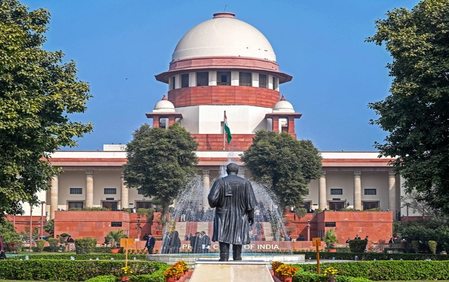
New Delhi, June 1 (IANS) The Supreme Court on Monday issued notice to the Centre on a Public Interest Litigation (PIL) seeking directions to ensure the effective functioning of statutory grievance redressal mechanisms under the Rights of Persons with Disabilities (RPwD) Act, 2016.
A Bench of Justices Vikram Nath and Prasanna B. Varale sought a response from the Union government and directed that the matter be tagged to a pending petition raising similar issues. The case has been listed for further hearing on July 21.
The PIL, filed by lawyer and disability rights advocate Shashank Pandey, has sought directions for the effective implementation of recommendations issued by the Chief Commissioner for Persons with Disabilities (CCPD) and State Commissioners, as well as measures to address gaps in the composition, resourcing, and functioning of Disability Commissions across the country.
According to the petition, the RPwD Act established the offices of the Chief Commissioner and State Commissioners as the primary enforcement and oversight bodies for protecting the rights of persons with disabilities.
However, it is alleged that these institutions have been rendered only partially effective due to persistent implementation failures.
Highlighting structural deficiencies, the petition stated that executive authorities frequently fail to comply with recommendations issued by Disability Commissions and, in many cases, do not even furnish reasons for such non-compliance, despite a statutory requirement to do so.
“In a large majority of cases, authorities neither comply with the recommendations nor provide any justification, thereby undermining the statutory mandate,” the plea submitted, adding that penal provisions meant to enforce compliance remain largely unused.
The petition further alleged that most Disability Commissions lack basic institutional infrastructure, including public-facing websites and online grievance redressal systems.
It claimed that only 4 State Commissioners for Persons with Disabilities currently offer online grievance registration, while 20 State Commissions do not have functional websites.
It also highlighted the absence of advisory committees envisaged under the RPwD Act to assist the Chief Commissioner and State Commissioners, stating that no such committees appear to have been constituted.
The plea raised concerns over vacancies in the disability rights watchdog. It said there has been no full-time Chief Commissioner for Persons with Disabilities since 2019, with senior government officials holding the position as an additional charge, contrary to the statutory framework.
Referring to a representation submitted to the Department of Empowerment of Persons with Disabilities in January this year, the petitioner said no action had been taken to address the issues flagged.
“The grievance redressal machinery for giving effect to such rights and entitlements has been rendered partially ineffective due to implementation gaps,” the petition said, adding that persons with disabilities continue to face “structural exclusion due to the ineffective functioning of statutory enforcement mechanisms”.
The plea has sought directions to strengthen enforcement powers and institutional accountability mechanisms under the RPwD Act to ensure “effective, uniform, and meaningful protection of disability rights across India”.
–IANS
pds/dan