

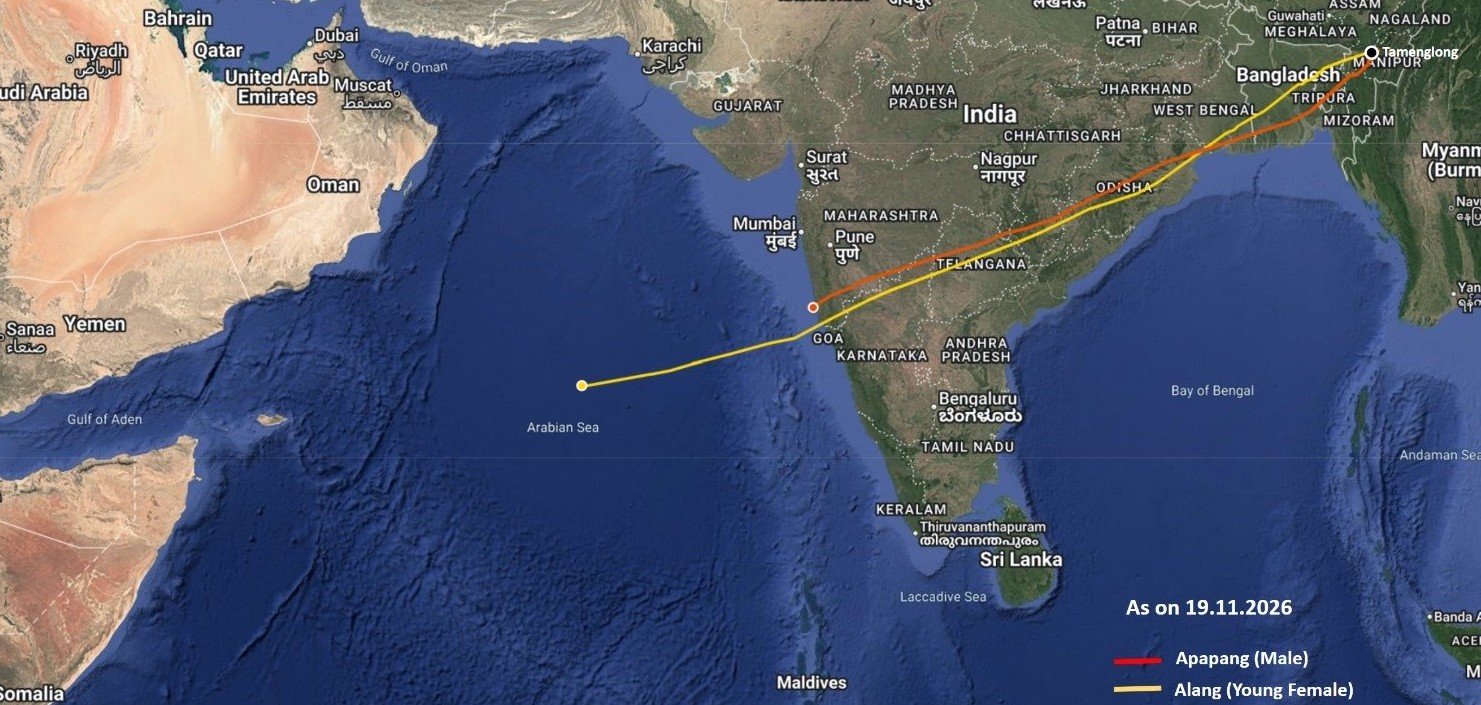
Kolkata, Nov 19 (IANS) Two satellite-tagged Amur falcons, Apapang and Alang, have commenced their trans-oceanic migration towards Africa after spending nearly 25 days roosting at Chiuluan in Manipur’s Tamenglong district, senior bureaucrat Supriya Sahu said on Thursday.
Sharing tracking updates on social media platform X, Sahu, Additional Chief Secretary for Environment, Climate Change and Forests, Tamil Nadu, stated that the male falcon Apapang has crossed peninsular India to reach the western coast near Goa, while the young female Alang is already well out over the Arabian Sea.
“Ahead lies one of nature’s most astonishing feats, a nonstop flight of nearly 3,000 km across the Arabian Sea towards Somalia. Imagine such tiny birds taking on an ocean with nowhere to land or rest! We are back on Amur Watch, following their journey with excitement, wonder and a little anxiety too. Safe skies, Apapang and Alang,” she posted.
Weighing barely 150 grams each, Apapang and Alang, along with a third falcon named Ahu, were fitted with satellite transmitters in November 2025 by scientists from the Wildlife Institute of India (WII) to study their migratory routes from northeastern India to wintering grounds in Africa.
During their previous recorded migration in 2025, all three birds completed nonstop flights across the Indian mainland and the Arabian Sea along distinct trajectories: Apapang covered roughly 6,100 km in six days and eight hours to reach Tanzania, Alang travelled around 5,600 km in six days and 14 hours to Kenya, and Ahu covered approximately 5,100 km in five days to reach northern Somalia.
Amur falcons (Falco amurensis) breed in parts of eastern Russia, northeastern China, and Mongolia before migrating south for the winter. Each autumn, thousands of the raptors halt at roosting sites in Nagaland and Manipur to feed heavily and build fat reserves ahead of their gruelling oceanic crossing.
According to a 2024 study published in the Journal of Raptor Research by a WII research team led by Suresh Kumar, the falcons rely extensively on subterranean termites during their northeast India stopover.
Analysis of around 1,200 regurgitated pellets collected from Pangti, Yaongyimchen, and Hakhizhe in Nagaland revealed that two termite species, Odontotermes feae and Odontotermes horni, form a major component of their diet, with researchers estimating that one million falcons can consume up to two billion termites in just over a fortnight.
Conservationists note that satellite telemetry provides critical data on flight durations, stopover habitats, and migratory corridors, underscoring the need for coordinated international conservation efforts across northern Asia, India, and Africa to safeguard the species.
–IANS
jg/dan