

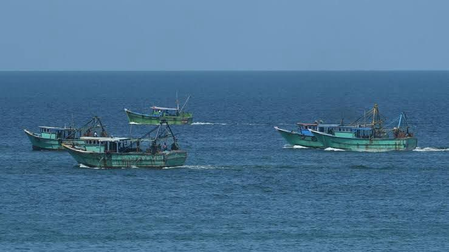
Chennai, July 4 (IANS) Tamil Nadu’s deep-sea fishing community has urged the Union government to permit data-enabled two-way satellite communication systems on fishing vessels, saying the technology is essential to improve safety, boost earnings and support the Centre’s efforts to expand deep-sea fishing.
The National Association of Fishermen (NAF) has submitted a representation to Union Communications Minister Jyotiraditya Scindia seeking approval for satellite-based communication services aboard fishing boats.
According to the association, existing vessel-monitoring systems are inadequate as they primarily provide location tracking, limited text messaging and costly voice communication, with two-way satellite calls costing around Rs 25 per minute.
The fishermen said modern satellite communication would transform deep-sea fishing by enabling continuous connectivity even hundreds of nautical miles away from the coastline, where conventional mobile networks are unavailable.
The demand assumes significance at a time when the Centre is actively promoting deep-sea fishing as a means to enhance marine exports and reduce pressure on coastal fish stocks.
The Department of Fisheries has already issued deep-sea access passes to encourage fishermen to venture farther into the sea in search of high-value species.
However, fishing organisations argue that expanding offshore operations without ensuring dependable communication infrastructure exposes fishermen to unnecessary risks.
A veteran of the fishing industry R. Manikantan, said uninterrupted satellite connectivity would provide fishermen with access to real-time weather forecasts, oceanographic information and fish-movement data while at sea.
Such information would help crews avoid hazardous weather conditions, improve navigation and identify productive fishing zones more efficiently.
Apart from safety, the technology is expected to offer significant commercial benefits. At present, fishermen return to shore without knowing prevailing market prices, leaving them with little bargaining power when selling their catch.
He said that two-way satellite communication would allow crews to transmit photographs and details of their catch directly to buyers while still at sea, negotiate prices in advance and land their catch only after securing favourable deals, thereby improving their income.
NAF Tamil Nadu State President Praveen Kumar said many fishermen operating in the Bay of Bengal and the Gulf of Mannar are reluctant to venture beyond 200 nautical miles because they have no reliable means of seeking help during emergencies.
He said approving affordable satellite communication would strengthen safety, increase confidence among fishermen and support the sustainable expansion of India’s deep-sea fishing sector.
—IANS
aal/rad