
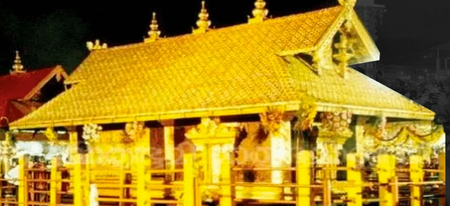
New Delhi, April 9 (IANS) The Union government on Thursday reiterated before the Supreme Court that restrictions at the Sabarimala temple are not rooted in gender discrimination, arguing that several temples across the country impose practices that are either male- or female-centric based on faith and tradition.
Appearing before a nine-judge Constitution Bench headed by Chief Justice of India (CJI) Surya Kant, Solicitor General (SG) Tushar Mehta submitted that the 2018 verdict allowing entry of women of all age groups into the Sabarimala temple proceeded on an incorrect assumption that men were treated as superior and women placed on a lower pedestal.
“I have given instances of temples where men are not allowed… There are temples where male priests are mandated to wash the feet of women devotees. There is the Pushkar temple, the only Brahma temple in the country, where married men are not allowed. There is also a temple in Kerala where men go dressed as women. So it is not a question of male-centric or female-centric beliefs. In the present case, it happens to be woman-centric,” SG Mehta told the Bench, also comprising Justices B.V. Nagarathna, M.M. Sundresh, Ahsanuddin Amanullah, Aravind Kumar, Augustine George Masih, Prasanna B. Varale, R. Mahadevan, and Joymalya Bagchi.
The apex court is currently examining larger constitutional questions relating to the interplay between religious freedom and fundamental rights.
During the hearing, Justice Nagarathna stressed the importance of inclusivity in religious spaces, observing that “everybody must have access to every temple and matha”, while clarifying that her remarks were independent of the Sabarimala controversy.
“If you say it is my practice that only my denomination must attend my temple and none else, that is not good for Hinduism,” she remarked.
Justice Aravind Kumar cautioned that such exclusionary practices could lead to societal divisions.
Senior advocate C.S. Vaidyanathan, appearing in the matter, countered that denominational temples — particularly private ones — have historically restricted entry to specific groups. He argued that such institutions, if not reliant on public funds or general footfall, may not necessarily violate constitutional principles.
“Question is whether it is contrary to the constitutional prohibition. If it is not contrary to public order, morality and health, what would be the realistic consequences,” he submitted.
The Centre has consistently maintained that the 2018 Sabarimala judgment warrants reconsideration, contending that the restriction in question is rooted in the unique nature of the deity and religious practices, rather than notions of patriarchy or gender bias.
In his written submissions, SG Mehta cited examples such as the Attukal Temple in Kerala, where men are not allowed entry during certain rituals, and the Chakkulathukavu temple, where male priests perform rituals washing the feet of women devotees. He also referred to the Kottankulangara temple, where men dress in women’s attire as an expression of faith.
–IANS
pds/vd