

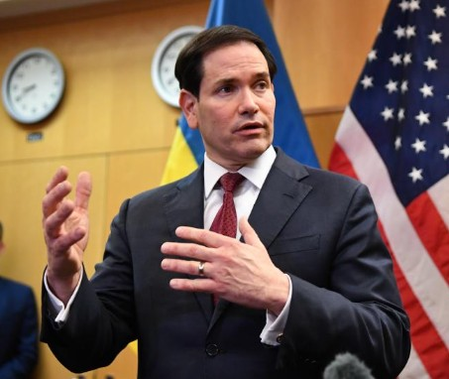
Washington, Nov 14 (IANS) US Secretary of State Marco Rubio invoked America’s history of expansion in a defence of national sovereignty, arguing that the country’s founding principles reflected an ambition to grow beyond its borders rather than retreat from the world.
In his address to the Federalist Society’s National Lawyers Convention on Friday (local time), Rubio presented expansion and national ambition as defining elements of American history and criticised what he described as constraints imposed by international institutions.
“America has always been a nation of irrepressible ambition — ambition which, since the very beginning, extended far beyond our borders,” he said. “Low ceilings and small horizons were never our destiny.”
Rubio linked that argument to his criticism of international judges and bureaucracies, saying that accepting their vision would conflict with his understanding of the country’s character.
“The history of our nation and our people brims with a hunger to expand, to grow, to explore and conquer, to stake a claim to new frontiers,” he said.
He did not identify a new territorial objective or announce an expansion policy in the excerpts.
Rubio cited the American Revolution and Alexander Hamilton’s opening Federalist essay in support of his interpretation. He argued that anger over British restrictions on westward expansion had helped drive the revolution, pointing to a grievance in the Declaration of Independence.
He also invoked Hamilton’s description of the stakes in the debate over ratifying the Constitution as including “the fate of an empire, in many respects the most interesting in the world.”
“We are not a passive, inward-looking people,” Rubio said in the excerpts. “To submit to the sterile vision of radical judges or soulless global bureaucrats would be to betray ourselves.”
He argued that American laws, constitutional arrangements and political traditions had developed because of the country’s ambition to become greater and stronger, not despite it.
Rubio also accused a global elite of using international law to advance its own interests while invoking universal principles. He said its commitment to democracy weakened when election results challenged those interests.
He criticised the International Criminal Court, saying Americans had not agreed to submit to its authority. The United States is not a party to the court’s founding treaty, though the court can exercise jurisdiction in certain circumstances involving non-member states.
Hamilton’s Federalist No. 1 discusses the proposed US Constitution, the survival of the Union and the welfare of its constituent states. Its opening paragraph contains the reference to the fate of an empire cited by Rubio, in the context of the constitutional ratification debate.
The Declaration of Independence includes a grievance about British restrictions on migration and new appropriations of land. According to the National Archives, a 1763 royal proclamation restricting colonial settlement west of the Appalachian Mountains heightened hostility toward the Crown.
–IANS
lkj/sd/