

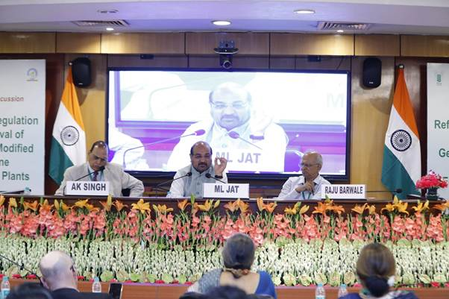
New Delhi, July 26 (IANS) A high-level roundtable of experts held here has called for science-based regulatory reforms to accelerate safe adoption of Genetically Modified (GM) and Genome-Edited (GE) crops in India, according to a statement issued by the Agriculture Ministry on Sunday.
The roundtable on “Reforms in Regulations and Approval of GM and GE Crop Plants” was organised by the Trust for Advancement of Agricultural Sciences (TAAS) in collaboration with the Indian Council of Agricultural Research (ICAR) and the Federation of Seed Industry of India (FSII).
The roundtable called for a science-based, transparent, efficient, and risk-proportionate regulatory framework with streamlined, time-bound approval processes accessible to both public and private innovators. It also emphasised that timely adoption of safe GM and GE crops is vital for enhancing climate resilience, productivity, nutritional security, farmer incomes, and the global competitiveness of Indian agriculture, the statement said.
Participants noted that while India has developed robust scientific capabilities and over three decades of experience in biosafety regulation, the regulatory framework must evolve to keep pace with advances in biotechnology, particularly genome editing, while maintaining the highest standards of biosafety and environmental protection.
The roundtable meeting was held to develop a roadmap for efficient approvals of GM and GE crops intended for national needs, ensuring regulatory efficiency and biosafety standards. The recommendations emerging from the roundtable will be consolidated into a comprehensive policy document for submission to the concerned Ministries and regulatory authorities to support evidence-based reforms in the regulation and approval of GM and genome-edited crop plants in India.
The event brought together over 80 participants including policymakers, agricultural scientists, regulators, industry leaders, economists, and international experts, to deliberate on modernising India’s agricultural biotechnology regulatory framework.
Addressing the event, Dr M.L. Jat, Secretary, Department of Agricultural Research and Education (DARE) and Director General, ICAR, emphasised the need for a balanced regulatory system that facilitates the safe deployment of modern biotechnologies to achieve food and nutritional security, climate resilience, and sustainable agricultural growth.
TAAS chairman R.S. Paroda emphasised that the recommendations emerging from the roundtable should serve as the basis for modernising India’s regulatory framework and creating an enabling policy environment that promotes responsible innovation while safeguarding human health, biodiversity, and the environment. He further stressed the need to review existing multiple guidelines to simplify testing procedures.
The roundtable observed that rapid advances in genome-editing technologies, including CRISPR-CAS-based systems, evolving global regulatory practices and the growing need for climate-resilient and sustainable agriculture necessitate a review and modernisation of India’s regulatory framework for GM and GE crops. While India has introduced a differentiated regulatory approach for certain categories of gene-edited products, further reforms are required to improve clarity, harmonisation and predictability across the regulatory system.
Dr M. Ramasami, Founder Chairman, Rasi Seeds (P) Ltd, stressed that an efficient, transparent, and predictable regulatory system is essential to translate scientific breakthroughs into technologies that benefit farmers, strengthen India’s seed sector, and enhance the country’s global competitiveness in agricultural innovation.
The inaugural session featured keynote lectures by Dr C.D. Mayee, President, South Asia Biotechnology Centre (SABC), on the imperative for regulatory reforms; Dr Rhodora Romero-Aldemita, Executive Director, ISAAA Inc., spoke on global developments and harmonisation of regulatory frameworks; and Graham Brookes, Agricultural Economist, PG Economics Ltd, UK, presented evidence on the economic benefits of GM and genome-edited crops worldwide, the statement added.
–IANS
sps/uk