
Washington, May 12 (IANS) The terror facilities in Pakistan, which had suffered a major damage during Operation Sindoor launched by the Indian military last year in the aftermath of the April 22, 2025 Pahalgam terror attack, are now undergoing large-scale clearing work, with construction materials and supplies visible across the sites, indicating rebuilding activity.
Following Operation Sindoor, terrorist organisation Jaish-e-Muhammad (JeM) shifted its key operational bases from Pakistan-occupied Kashmir to Khyber Pakhtunkhwa (KPK), considering the latter as more defensible after Indian strikes left PoK increasingly vulnerable, a report said on Tuesday.
The relocation is being carried out “with the direct facilitation of Pakistan’s state structures”, while visible JeM gatherings were held under police protection, along with involvement of the radical Islamist group Jamiat Ulema e Islam (JUI), said the US-based Middle East Media Research Institute (MEMRI), citing media reports.
Under Operation Sindoor, the Indian Army conducted strikes on nine terror-linked sites associated with the banned groups JeM, Lashkar-e-Taiba (LeT), and Hizbul Mujahideen (HM) across Pakistan and PoK.
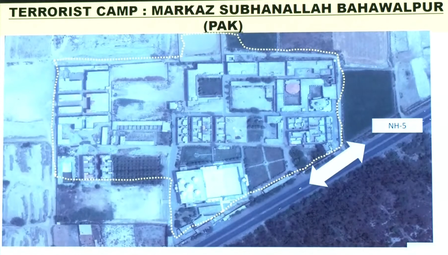
“Satellite imagery shows renewed construction activity at the Jamia Subhan Allah compound, located beside the N-5 National Highway in Bahawalpur. Images dated April 14, 2026, reveal heavy machinery and multiple construction vehicles deployed across the site,” the MEMRI report detailed.
“High-resolution satellite imagery obtained from the US-based space technology company Vantor shows that the mosque’s damaged domes have since been restored. The repaired domes appear noticeably darker in colour, suggesting recent cement work, compared to the lighter-toned paint seen in images captured prior to the strikes,” it added.
According to the report, reconstruction efforts at JeM-linked sites appear to extend beyond Bahawalpur. It added that satellite imagery from April 22 this year shows similar developments at the Syedna Bilal Mosque in Pakistan-occupied Kashmir (POK) – another site associated with the group.
Pakistan continues to be under observation by the Asia Pacific Group (APG) on Money Laundering, which assesses countries’ adherence to Financial Action Task Force (FATF) standards on terror financing and anti-money laundering measures.
“Even so, international media reported that social media accounts allegedly associated with JeM had hinted at fundraising campaigns conducted through digital wallets to support reconstruction work at the Subhan Allah complex,” it noted.
Addressing concerns over Pakistan-based terror groups, FATF President Elisa de Anda Madrazo said that nations previously removed from the grey list remain vulnerable to exploitation by money launderers and terrorist financiers, urging governments to maintain strong enforcement mechanisms to counter such threats.
“Yet, only months after those remarks, visible reconstruction work at sites linked to JeM appears to cast doubt on how effective the monitoring process has been in practice,” the report noted.
Highlighting Pakistan’s removal from the FATF grey list in October 2022, the report noted that even prior to Operation Sindoor, an earlier media investigation had documented signs of expansion at JeM’s headquarters following the country’s delisting from the monitoring list.
–IANS
scor/as