
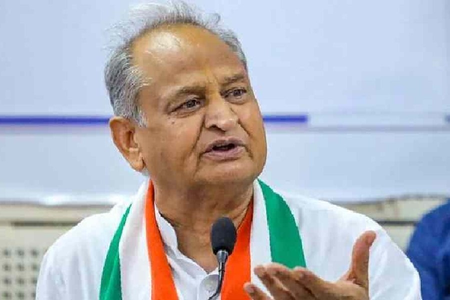
Jaipur, June 10 (IANS) Six years after Rajasthan’s dramatic 2020 political crisis shook the Congress government due to Gehlot-Pilot rift, the controversial phone-tapping case has returned to the political spotlight as former Chief Minister Ashok Gehlot’s ex-Officer on Special Duty (OSD), Lokesh Sharma, has demanded that investigating agencies summon and question the former CM.
He claimed that he had already submitted substantial evidence linking Gehlot to the alleged surveillance operation.
Sharma expressed surprise that no action has been taken despite the evidence he says he provided to the Delhi Police. “It has been quite some time since I submitted the entire data related to the alleged phone tapping. I am surprised that no action has been taken on those facts,” Sharma told IANS.
The former OSD, who was arrested in 2021 in connection with a phone-tapping case registered on the complaint of Union Minister Gajendra Singh Shekhawat, was later granted anticipatory bail.
In 2024, Sharma submitted a pen drive, a laptop, a mobile phone, and a detailed statement to the Crime Branch of Delhi Police, claiming the devices contained evidence supporting his allegations.
According to Sharma, he also provided a seven-page statement detailing events that allegedly took place on July 16, 2020, at the height of Rajasthan’s political turmoil. He claimed that a pen drive containing recorded conversations was handed to him by the then Chief Minister and that he was instructed to circulate the audio clips among media organisations.
“I have submitted all evidence in support of my statement. Ashok Gehlot should now be called for interrogation,” Sharma asserted.
The controversy traces its roots to the intense power struggle within the Congress in 2020, when then Deputy Chief Minister Sachin Pilot rebelled against Gehlot’s leadership along with 18 MLAs. The revolt pushed the Congress government to the brink and triggered a fierce political battle over the state’s future.
During the crisis, the Gehlot government released audio clips purportedly revealing attempts to topple the government through political manoeuvring and alleged horse-trading. However, the release of the recordings sparked a larger controversy. The BJP and leaders from the Pilot camp questioned how the state government had obtained the conversations in the first place. Allegations soon emerged that the phones of political leaders, legislators, and others had been illegally intercepted during the political standoff. The accusations became serious enough for the Union Home Ministry to seek a report from the Rajasthan government.
At the time, Rajasthan Police denied tapping the phones of any MLA or MP and dismissed the allegations as baseless. Meanwhile, phone tapping was discussed and confirmed in the Rajasthan assembly also. Soon after the controversy, BJP MLA Kalicharan Saraf in the Assembly had asked, “Is it true that phone tapping cases have come up in the last few days? If yes, under which law and on whose orders? Place full details on the table of the House.”
In its reply, given after a delay of several months in March 2021, the government has said: “In the interest of public safety or public order, and to prevent the occurrence of a crime which might risk public safety or public order, telephones are intercepted after an approval by a competent officer under the provisions of section 5(2) of The Indian Telegraph Act, 1885, and section 419 (A) of The Indian Telegraph (Amendment) Rules, 2007, as well as section 69 of the Information Technology Act, 2000. “Telephone interception has been done by the Rajasthan Police under the above provision and only after obtaining permission from the competent officer.”
The government at that time did not specify the telephone numbers that were intercepted, nor the time for which they were put under surveillance. It has only said that “interception cases are reviewed by the Chief Secretary, Rajasthan, who presides [over the meetings] as per rules. All cases till November 2020 have been reviewed.”
Soon after, Gehlot in the Assembly said, “There is no such tradition in Rajasthan. There are laws for telephone interception, and telephones are intercepted only under the provisions of these laws. Telephones are intercepted after approval of the competent authority under the provisions of the Indian Telegraph Act 1885, the Indian Telegraph (Amendment) Rules 2007, and the IT Act 2000. The Govt. does not interfere in it at all”, he had said.
The issue resurfaced in 2024 when Gehlot’s OSD Sharma publicly alleged that Gehlot had personally handed him an audio clip involving Shekhawat and Congress leaders for media dissemination. The allegation carried significant political weight because Sharma had been one of Gehlot’s closest aides during the crisis.
Former Deputy Chief Minister Sachin Pilot also called for a fair and comprehensive investigation into the phone-tapping allegations, adding further political significance to the matter. Pilot spoke on the phone tapping incident in 2025, also when he said, “Phone tapping is a serious crime, whether it happened now or in the past, it must be thoroughly investigated.”
With Lokesh Sharma now again demanding accountability and seeking Gehlot’s interrogation, the phone-tapping controversy continues to cast a long shadow over Rajasthan politics, keeping alive one of the most contentious chapters of the Gehlot-Pilot era.
–IANS
arc/skp