
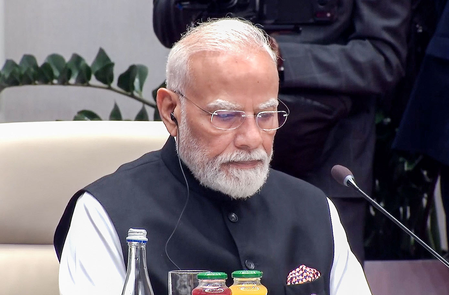
New Delhi, Oct 6 (IANS) With his tenure starting from swearing-in as Gujarat Chief Minister on October 7, 2001, to his present-day responsibilities, Prime Minister Narendra Modi has completed 25 years in uninterrupted executive office, joining a relatively small group of leaders who have spent a quarter-century or more continuously as heads of government or in similar leadership roles.
In India, he has already surpassed a record, held earlier by Pawan Kumar Chamling, who was in office as the longest-serving head of an elected government, being the Chief Minister of Sikkim from December 1994 to May 2019. That marked the Sikkim Democratic Front leader’s term in office at 24 years and 165 days.
Among other Chief Ministers who have served continuously in office over long periods are Naveen Patnaik in Odisha and Jyoti Basu in West Bengal. In Odisha, the Biju Janata Dal leader served in office between March 2000 and June 2024, totalling 24 years and 99 days. Patnaik, now 79, remains popular among political parties, where he has largely been hailed for a clean image, disaster management capabilities, and promoting women’s empowerment programmes.
Jyoti Basu served as the Chief Minister of West Bengal between June 1977 and November 2000, recording 23 years and 137 days in office. He is known to have implemented land reforms with his Communist Party of India (Marxist)-led Left Front government, concentrating on rural development. Globally, Singapore’s first and longest-serving Prime Minister Lee Kuan Yew was in office from 1959 to 1990, a continuous 31 years, and is often cited as the modern benchmark for democratic executive longevity. When he declared Singapore’s independence from Malaysia in 1965, it was a bold gamble, but by 1990, a once-impoverished island had made its place among the world’s wealthiest nations per capita.
In Cambodia, meanwhile, Hun Sen served as Prime Minister from 1985 until 2023, making him one of the longest-serving heads of government in the contemporary world. And in Malaysia, Mahathir Mohamad, as Prime Minister from 1981 to 2003, and again from 2018 to 2020, served a cumulative tenure of over 24 years. Although not continuous, he remains among the longest-serving elected leaders in modern Asia.
Also, Russia’s Vladimir Putin has been in office twice, as President and Prime Minister, serving a cumulative period of 27 years and continuing. Among other leaders who have served long terms are Helmut Kohl (1982-1998) and Angela Merkel (2005-2021), in office for over 16 years as Germany’s Chancellor, where the former scored comparatively 10 days more in power.
While in China, Xi Jinping is said to have been the general secretary of the Chinese Communist Party (CCP) and chairman of the Party Central Military Commission (CMC) since 2012. He has been the President of China since 2013.
Back in India, what makes Prime Minister Modi’s 25-year mark unusual is not just the length of the term, but that it has been achieved through repeated electoral mandates in a highly competitive and the world’s largest democracy. And the journey continues to make “Viksit Bharat”. There are other instances across the world where leaders have served decades in executive offices but hold controversial records as rulers.
–IANS
jb/uk