
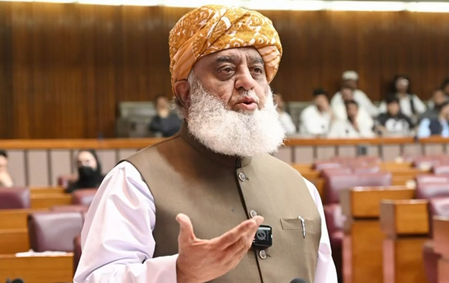
Islamabad, July 18 (IANS) Pakistan’s political landscape has long been shaped by one enduring reality: “governments may change, but the military remains the country’s most powerful institution”. Against that backdrop, Pakistani Islamist leader and Jamiat Ulema-e-Islam-Fazl (JUI-F) chief Maulana Fazlur Rehman’s open challenge to Army chief Asim Munir represents a striking break from convention, a report has detailed.
When a veteran insider questions the military’s political authority, the establishment has little choice but to take notice, according to a report in the ‘Strat News Global’.
“Prime Ministers have been elected, dismissed, jailed and exiled. Political parties have risen and fallen. Yet through it all, the army has remained the ultimate arbiter of power, ruling directly through coups or exercising enormous influence from behind the scenes. That is why Maulana Fazlur Rehman’s latest confrontation with Pakistan’s military leadership has resonated far beyond routine opposition politics,” the report mentioned.
According to the report, Munir now wields more authority than any Pakistani military leader since former army chief Pervez Musharraf.
Munir’s position was further strengthened by a five-year extension as Army Chief, along with his promotion to the five-star rank of Field Marshal — only the second such appointment in Pakistan’s history — and his concurrent role as the country’s first Chief of Defence Forces.
Collectively, these positions have cemented his position at the top of Pakistan’s security establishment, the country’s real seat of power, said the report.
Rehman’s criticism was sparked by Munir’s call for civilians to organise armed militias, or lashkars, to assist security forces in tackling escalating militant violence in Khyber Pakhtunkhwa and Balochistan.
“Pakistan has experimented with such militias before, often with mixed and sometimes tragic results. Tribal leaders who sided with the state became targets for militant groups, while local communities found themselves trapped between insurgents and security forces,” the report noted.
Rehman warned that repeating the experiment would only worsen Pakistan’s internal conflicts.
He said that national defence rests with the state, not civilians, cautioning that encouraging people to take up arms would sow generations of violent feuds, breed lawlessness, and reflect the state’s inability to safeguard its citizens.
For decades, Pakistan’s armed forces, the report said, derived “moral authority from the language of sacrifice and martyrdom”.
Rehman challenged that narrative, arguing that soldiers willingly join the military and are paid by taxpayers to safeguard the country.
“You are taking your salaries from the taxes earned through our blood and sweat. I have taken no salary. I will not form any Lashkar,” Strat News Global quoted him as saying.
In a sharp rebuke directed personally at Munir, Rehman said, “If you want to do politics, take off the uniform and come; participate in the elections.”
Highlighting that the criticism came from a veteran insider who has spent decades navigating Pakistan’s power structure, the report said, “When such a figure openly rejects the military’s security doctrine, questions its political legitimacy and dares Pakistan’s most powerful general to seek a democratic mandate, it suggests that the country’s long-standing civil-military compact is coming under fresh strain.”
–IANS
scor/as