
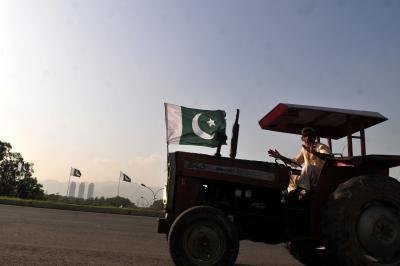
New Delhi, Feb 10 (IANS) The Heritage Institute’s Index of Economic Freedom has classified Pakistan as a “repressed” economy, ranking it 150th out of 184 economies, with a score of 49.1 out of 100 for the year 2025.
The Heritage Institute’s Index of Economic Freedom measures 12 economic freedoms, which include: property rights, government integrity, judicial effectiveness, tax burden, government spending, fiscal health, business freedom, labour freedom, monetary freedom, trade freedom, investment freedom, and financial freedom.
These 12 institutional and structural pillars can be considered conditions for sustainable economic growth and development in a country.
The report noted: “The government has demonstrated little commitment to much-needed economic reform. Efforts in key areas have been marginal at best. Measures to strengthen the management of public finance and reform outmoded economic structures have met institutional resistance. A judiciary that is susceptible to political interference and corruption undercuts property rights. Neither the entrepreneurial environment nor private-sector dynamism has been improved to any meaningful degree. The labour market remains stagnant. Much of the workforce is underemployed in the informal sector. High inflation has disrupted monetary stability.”
The cut-off date for including data in the 2025 Index was June 2024. Thus, it makes sense to point out problems such as high inflation, which was around 12 per cent at the time and already on a downward trend, or a perceived lack of commitment to reform, when the national debate was focused on avoiding default rather than on structural reforms.
An article by Pakistani economist Ali Salman points out that on two accounts, the Heritage Index does not seem to reflect the actual dynamics, which is a fundamental problem and highlights the limitations of all such indices.
The index awarded a rather high score of 88.9 per cent for “government spending” and 78.3 per cent for “tax burden”. This is because the index relies on two numbers: government spending and tax collection as a percentage of GDP. Pakistan’s government spending is around 20 per cent of GDP, while its tax-to-GDP ratio is 10 per cent.
From an absolute perspective, 20 per cent of GDP does not indicate an excessively large government. However, when one notes that interest payments and defence spending account for almost 70 per cent of total expenditure, and when we consider wasteful spending in other areas, then a high score for public spending becomes largely irrelevant, the article observed.
Similarly, while a 10 per cent tax-to-GDP ratio may sound like a country with a low tax burden and, therefore, high economic freedom, the tax burden on those who actually pay taxes remains very high. Fast forward to the first quarter of 2026. How will the next edition of the Index of Economic Freedom view economic freedom in Pakistan?
Since the last edition of the index was published, the tax burden on taxpayers has increased substantially. Pakistan’s top marginal tax rate on individual incomes has risen from 35 per cent to 45 per cent. The super tax, initially introduced as a temporary levy on corporate incomes above a certain threshold to meet the costs associated with internally displaced populations, has recently received judicial cover. This has raised the effective tax burden on large corporations to more than 50 per cent, the article added.
–IANS
sps/vd