
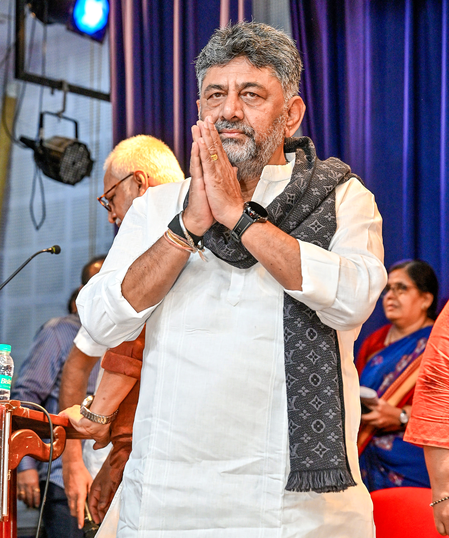
Bengaluru, July 3 (IANS) One month after D.K. Shivakumar assumed office as the Chief Minister of Karnataka, the state continues to function with only 13 ministers, leaving 20 Cabinet berths vacant despite the Council of Ministers being permitted to have up to 34 members.
The prolonged delay in Cabinet expansion, attributed to political calculations and lobbying within the ruling Congress, has left several key departments without dedicated ministers at a time when the state is grappling with a severe drought, law and order challenges, and multiple administrative issues.
Shivakumar was sworn in as Chief Minister on June 3 following a prolonged power-sharing tussle with his predecessor Siddaramaiah. His elevation was expected to bring an end to years of uncertainty and factionalism within the Karnataka Congress. However, one month later, the Cabinet expansion remains pending, with the internal political balancing exercise continuing to dominate the party’s agenda.
Siddaramaiah, now a member of the Congress Working Committee (CWC), has largely remained silent in public, senior leaders who are aspirants for ministerial berths have also refrained from openly expressing their dissatisfaction.
Senior ministers, including Krishna Byre Gowda, Ramalinga Reddy and K.H. Muniyappa, who openly made their unhappiness clear over allotment of ministries, have focussed on governance. Besides, the absence of a full-fledged Cabinet has placed additional responsibilities on the existing ministers.
In a move seen as an attempt to project unity, Chief Minister Shivakumar visited Siddaramaiah’s residence in Bengaluru along with his wife Usha Shivakumar and brother, former MP D.K. Suresh on the occasion of completion of one month at the coveted post. The leaders held a breakfast meeting and discussed the political developments in the state.
The government has also had to contend with a series of political and administrative controversies during its first month. Ministers, including Priyank Kharge, M.B. Patil and Krishna Byre Gowda, have defended the government amid criticism over a spate of crimes, the controversy surrounding Priyank Kharge’s remarks on the Rashtriya Swayamsevak Sangh (RSS), allegations by the BJP and JD(S) that the government is interfering in the ongoing Special Intensive Revision (SIR) of electoral rolls, and the political confrontation between Union Minister H.D. Kumaraswamy and Chief Minister Shivakumar over the proposed Bidadi Township project near Bengaluru.
Despite the incomplete Cabinet, Shivakumar has announced several key policy initiatives. These include free bus passes for all students across Karnataka, the establishment of Bharat Jodo Youth Associations in every gram panchayat and urban ward with a grant of Rs 10 lakh each, exemption from Occupancy Certificates (OC) for obtaining permanent electricity connections for new residential buildings up to 2,500 square feet, and the statewide conversion of ‘B’ Khata properties to ‘A’ Khata.
Other major announcements include a Rs 2,000 crore programme to make Bengaluru’s roads pothole-free, the establishment of a Private Sector Employment Exchange, a six-month deadline to fill 72,000 government vacancies, and a proposal to create a separate ‘Praja Seve’ (Public Service) Ministry to address public grievances.
The government has also initiated the re-verification of beneficiaries under its flagship guarantee schemes and is considering a revision in RTC bus fares amid mounting financial pressures.
Political observers, however, argue that governance cannot depend solely on the Chief Minister and a handful of ministers, especially when several important portfolios continue to await full-time political leadership.
The Opposition has repeatedly targeted the government over the delay.
BJP state president B.Y. Vijayendra alleged that the Chief Minister was using the ongoing SIR exercise as an excuse to postpone the Cabinet expansion.
“The Chief Minister knows the reality that if the Cabinet is expanded, the very foundation of this government will be shaken. That is why he is using the SIR exercise as an excuse,” Vijayendra alleged.
Congress insiders maintain that the party’s central leadership is in no hurry to expand the Cabinet, fearing that accommodating some leaders while leaving out others could trigger dissidence. With only 20 vacancies available and several senior leaders competing for key portfolios, the leadership is also said to be considering inducting new faces alongside experienced legislators.
As elections to urban local bodies and other local government institutions approach, the decision on when to expand the Cabinet becomes more politically important. The Congress leadership is trying to balance two competing priorities: Ensuring effective governance by appointing more ministers, and managing internal party dynamics by deciding who gets ministerial posts without triggering dissatisfaction.
–IANS
mka/rad