
New Delhi, Jan 24 (IANS) Chief Election Commissioner (CEC) Gyanesh Kumar said on Saturday that the most compelling testament to the success of the Special Intensive Revision (SIR) of electoral roll in Bihar was that not a single appeal was filed against the final voters’ list, establishing its sanctity and credibility.
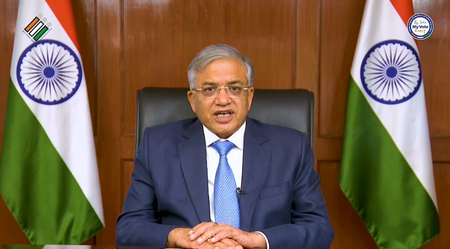
In a message released on the eve of the 16th National Voters’ Day, the CEC said, “Elections conducted on this strong foundation proved historic, recording the highest voter turnout since 1951 at 67.13 per cent, with women electors registering an unprecedented participation rate of 71.78 per cent.”
CEC Kumar said that SIR of electoral rolls was initiated with the objective of ensuring purity of the voters’ lost, which is the bedrock of democracy.
The SIR’s key objective is to ensure that every eligible elector’s name is included in the electoral roll and that every ineligible name is removed, he added.
“This exercise has been successfully completed in Bihar and is presently being smoothly conducted in 12 states and Union Territories of the country. It will soon be rolled out in the remaining states as well,” said CEC Kumar, highlighting the various achievements of the Election Commission of India in the just concluded year.
Calling upon young voters to fight misinformation, the CEC asked voters, especially, the youth to vote without fail, to become ambassadors of democracy themselves, and to inspire others to participate in the electoral process.
“I call upon our young electors to lead the fight against misinformation, disinformation, and false narratives. For this, it is essential that they remain fully informed about electoral processes and the various initiatives of the ECI, and actively disseminate accurate information among their friends, families, and communities,” he said.
Referring to the ECI’s activities in 2025, the CEC said that the Commission undertook around 30 major initiatives including capacity building of election officials through intensive training at the India International Institute of Democracy and Election Management (IIIDEM) in New Delhi, under which more than 5,000 Booth Level Officers (BLOs) and BLO Supervisors from various states and Union Territories were trained.
He also showcased the launch of the ECINet App; the introduction of mobile deposit facilities at polling stations and the decision to cap the number of electors per polling station at a maximum of 1,200 for voter convenience.
“In 2025, the ECI also successfully conducted the Vice-Presidential election apart from conducting several by-elections,” CEC Kumar said.
“Recognising the imperatives of the digital age, the ECI in another path-breaking reform has made all elector services available to citizens on a single platform through the ECINet App, an initiative that reflects the Commission’s technological commitment and administrative competence,” he added.
The CEC also mentioned the world’s largest international conference on election management and electoral processes organised by the ECI from January 21 to 23.
The Election Commission of India was established on January 35, 1950, a day prior to Republic Day.
Every year, January 25 is commemorated as National Voters’ Day, dedicated to the electors of our democracy.
–IANS
rch/khz