

Kathmandu, Sep 20 (IANS) Nepal’s Ministry of Foreign Affairs has established an Environment Diplomacy Division for the first time to strengthen climate diplomacy amid devastating floods that have severely affected the country.
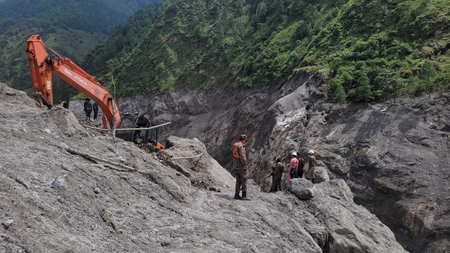
The bodies of 1,411 people swept away by the deadly floods have been recovered, while 5,875 people — including Nepali and foreign nationals — remained missing as of Saturday evening following the devastating floods of August 26, according to the National Disaster Risk Reduction and Management Authority.
Experts have identified global warming caused by climate change as a likely factor that contributed to the collapse of a Himalayan slope, triggering catastrophic flooding in Nepal.
World Weather Attribution said in a report last week that human-caused global warming had thinned glaciers and thawed mountain permafrost, which likely contributed to the destabilisation of a Himalayan slope that collapsed on August 26, causing catastrophic flooding in Nepal.
World Weather Attribution (WWA) is an international scientific collaboration that analyses whether and to what extent human-caused climate change influences the intensity and likelihood of specific extreme weather events.
“Warming and permafrost degradation likely weakened the source rock wall by increasing bedrock temperatures and thawing ice within fractures. Loss of ice bonding reduces fracture strength, while meltwater can increase water pressure and further destabilise pre-existing geological weaknesses,” the report said.
“Thus, permafrost degradation may have acted as an additional climate-related factor preconditioning the slope for failure.”
As the risk of disasters grows in the wake of the devastating floods, the Nepali government decided to establish a separate division within the Foreign Ministry to carry out focused climate diplomacy.
“The ministry decided to set up the division considering the growing impacts of climate change and the need to address emerging challenges through a dedicated institutional mechanism,” the Foreign Ministry said in a statement.
Nepal has consistently participated in national, regional and international forums on climate change and environmental protection.
“The new division has been set up to advance these efforts in a more coordinated and institutionalised manner,” the ministry said. “The division will facilitate international diplomatic initiatives related to climate and environmental issues and coordinate with relevant agencies.”
Foreign Minister Shishir Khanal said Nepal has been continuously working on climate diplomacy at various international forums.
“Now, there is a need to institutionalise these efforts further,” he said. “Climate diplomacy cannot be advanced simply by focusing on participation in events ranging from one Conference of the Parties (COP) to another or in other international programmes.”
He said the institutional structure of the division could be strengthened in the future based on its needs and workload.
The Minister also emphasised that climate diplomacy should not focus only on issues related to the impacts of climate change and disasters, but should regularly advance Nepal’s priorities and initiatives in climate diplomacy.
The Foreign Ministry’s move comes just ahead of the 81st Session of the United Nations General Assembly (UNGA), where Nepal plans to raise the issue of climate change and its growing impacts on countries such as itself.
The Nepali government has already decided that Prime Minister Balendra Shah will participate in the High-Level Week of the 81st Session of the UNGA.
He is set to leave for New York on September 22, leading the Nepali delegation, and is scheduled to address the General Debate of the UNGA on September 24.
Khanal is leaving for New York on Sunday evening, the Foreign Ministry said.
–IANS
scor/sd/