
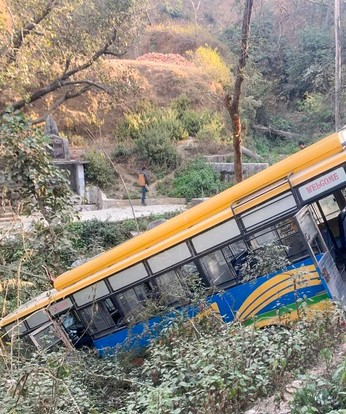
Kathmandu, Feb 23 (IANS) At least 17 people died after a bus travelling from western Pokhara to the capital Kathmandu plunged into the Trishuli River in the central district of Dhading early Monday, a senior official at the District Administration Office, Dhading, said.
“We have sent 17 people who appear to have died on the spot for medical confirmation,” Chief District Officer of Dhading, Bijaya Raj Subedi, told IANS. “We have also sent 27 others for treatment at different local hospitals and Kathmandu-based hospitals.”
The bus plunged about 300 metres below the road to the riverbank at around 1:30 am on Monday in the Bhaisigauda area of Benighat Rorang Rural Municipality. “The cause of the accident has not yet been identified, as the bus was travelling in its own lane,” Subedi said.
District authorities confirmed that 44 people were travelling on the ill-fated passenger bus.
Personnel from the Nepali Army, Armed Police Force, Nepal Police, and local residents were mobilised for the rescue operation. Authorities said the operation was hampered by nighttime conditions, difficult terrain, and a lack of rescue equipment.
Subedi said the first phase of the rescue operation was completed at around 6:30 am.
Nepal has been witnessing a rise in road accidents in recent years, along with an increase in the number of vehicles plying on the roads. A decade ago, 4,999 road accidents were reported, according to the Traffic Police Office.
In the fiscal year 2024–25, the country recorded 7,669 road accidents and 190 deaths, the office said. Of the total accidents, 278 were classified as serious. Apart from the enormous human toll, road safety also has a major economic impact.
A World Bank study in Nepal showed that the economic cost of road traffic injuries has tripled since 2007 and is equivalent to 1.5 per cent of the gross national product.
Road crashes also have a devastating and disproportionate impact on the poor. More than 70 per cent of all road fatality victims in Nepal are vulnerable road users, such as pedestrians, cyclists, and motorcyclists, the World Bank said.
–IANS
scor/rs