

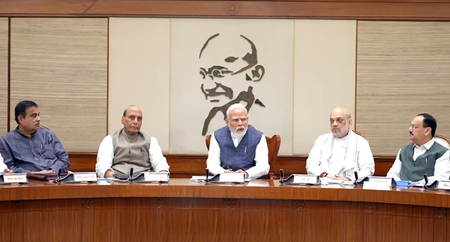
New Delhi, Oct 6 (IANS) Prime Minister Narendra Modi marks 25 uninterrupted years in public executive office on Tuesday, October 7, establishing a zero-tolerance security framework that transformed India’s counter-terrorism doctrine from strategic restraint to direct punitive strikes across borders.
His quarter-century tenure, spanning term as the Chief Minister of Gujarat and his leadership as Prime Minister, prioritised national security, intelligence strengthening, and police modernisation.
The foundation of his internal security approach was laid during his 12.5-year tenure as Gujarat chief minister. As the head of a state with a strategically important coastline and international border, Narendra Modi, as the Chief Minister, prioritised strengthening Gujarat’s maritime and land borders.
According to officials in the knowhow of strategic policy-making, the administration under Narendra Modi, first in the state and then at the Centre, laid a strong emphasis on improving intelligence gathering, modernising the police force and advocating tougher laws to combat terrorism.
As Gujarat chief minister, one of the major security challenges he faced was the Akshardham temple attack on September 24, 2002. He quickly recognised the gravity of the situation and decided to bypass the usual bureaucratic delays in responding to the crisis. He coordinated with the Centre to airlift National Security Guard (NSG) commandos, who led Operation Vajra Shakti. The terrorists were eventually neutralised by daybreak, the official said.
The next challenge was the 2008 Ahmedabad serial blasts by the Indian Mujahideen. This incident is still considered to be one of the most audacious attacks by the Indian Mujahideen. As many as 21 blasts were triggered in a span of 70 minutes killing 56 innocent people.
As chief minister, he oversaw a unit of Gujarat Police transitioning into specialised tactical unit. The team was given operational freedom and, in the days ahead, it went to crack the Indian Mujahideen’s nationwide logistics network within a month.
When Narendra Modi took the charge of Prime Minister’s office, he made it clear that his government wasn’t seen as soft on terror, rather punishing the country’s enemies with punitive strikes. It chose not to send diplomatic notes to countries like Pakistan following any terror incident and rather replied back in the same coin.
The first visible shift after PM Modi assumed office was during the Uri terror attack in 2016. As many as 19 Indian soldiers were martyred after terrorists of the Jaish-e-Mohammed stormed an army camp and opened fire.
The Modi government gave the forces the go-ahead to carry out surgical strikes across the border. The Indian Army destroyed several terror camps, launchpads while neutralising scores of terror.
Experts say that Modi government shattered the historic precedent of staying within the International Border during retaliations.
The next challenge came in 2019 when a Jaish-e-Mohammed suicide bomber ambushed a van carrying personnel of the CRPF. 40 personnel were killed in the attack.
Officials say that this was a very challenging situation. The government wanted the armed forces to respond strongly to avenge this attack. The Balakot air strikes followed in which a terror facility of the Jaish-e-Mohammed was destroyed.
The government established a new doctrine and that India would penalise the sponsors of terror within their own borders, disregarding traditional nuclear blackmail.
Then, one of the biggest security challenge was when Lashkar-e-Tayiba terrorists carried out the Pahalgam attack in which innocent tourists were killed after being asked about their religion. The entire nation was enraged and wanted a response stronger than Uri and Balakot.
Officials say that the Modi government was under immense pressure. However, the response not only had to be strong but structured. Further there had to be an element of surprise as the Pakistanis were gearing up for a strong response by India.
The Indian armed forces hit the Pakistani terror eco-system hard by executing Operation Sindoor. The precision strikes razed to rubble terror infrastructure of the Lashkar-e-Taiba, Jaish-e-Mohammed and Hizbul Mujahideen. Several terrorists were killed in the operation.
Operation Sindoor saw the India’s national security doctrine make a big shift, under Prime Minister Narendra Modi. Acts of terror would no long be treated as cross-border attacks, rather it would be treated as an “act of war”.
PM Modi’s emphasis on zero tolerance towards terror has rewritten India’s security doctrine.
“Strategic restraint has been replaced with an unyielding zero-tolerance policy,” an official aptly summarized.
— IANS
vn/snj/mr