

Mumbai, Oct 28 (IANS) The Airline Operators Committee (AOC) and Mumbai International Airport Ltd (MIAL) on Wednesday held a constructive dialogue to align on the dual-airport strategy for the Mumbai Metropolitan Region.
The operator presented detailed redevelopment schedules for Terminal 1 (T1) of the Chhatrapati Shivaji Maharaj International Airport (CSMIA), reiterating the critical urgency of demolishing T1— delayed for over nine years. The structural audit reports by Structwel (2017) and IIT Bombay (2024) have highlighted the urgency of undertaking the redevelopment, according to the CSMIA spokesperson.
CSMIA has a total capacity of around 55 mppa. The temporary transition of 5 mppa of traffic accounts means that 91% of the current traffic at CSMIA remains unaffected. The total capacity of CSMIA after the redevelopment of T1 and T2 will increase to 65 mppa.
It was clarified by MIAL that the T1 demolition and the resultant temporary reduction in CSMIA traffic are already incorporated in the approved tariff order, following extensive stakeholder consultations. The airport operator also shared the vision plan for the new Terminal 1, CSMIA.
To facilitate this transition, leading carriers IndiGo, Air India, and Akasa Air have finalised transition plans for their international flights to Navi Mumbai International Airport (NMIA), accounting for around 3 million passengers per annum (mppa). To meet the 5 mppa target capacity, MIAL proposes to temporarily transition the balance slots out of CSMIA T2 for the Northern Summer 2027 season (NS27).
MIAL has requested the airline operators to share their transition plans no later than 3rd November 2026 so that the final transition plan of 5 mppa can be achieved. The airport operator assured the airlines that the temporarily transitioned international traffic of 5 mppa will be fully restored to CSMIA once the T2 expansion is completed.
This phased, equitable transition will ensure passenger safety and minimal operational disruption while developing Mumbai as a world-class aviation hub.
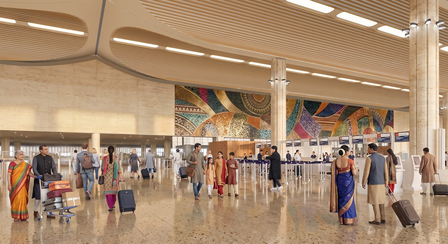
CSMIA shared artistic impressions outlining its vision for the redevelopment of Terminal 1 (T1) during its meeting on Wednesday with the Airport Airline Operators Committee (AOC). These visuals convey the passenger-centric architectural aspirations for Mumbai’s future gateway, presenting a vision of the terminal’s intended character and experience rather than a definitive preview.
Commissioned in 1964, the ageing T1 is past its prime. Severe safety and structural vulnerabilities highlighted in independent audits by Structwel (2017) and IIT Bombay (2024) have made replacing this sixty-year-old facility an urgent necessity for public safety. Now, Mumbai is ready to shed the old and embrace the extraordinary.
A Passenger-Centric Architectural Vision, the CSMIA spokesperson said.
The artistic impressions envisage a terminal designed around passengers and the needs of Mumbai’s growing commercial capital. More than a facelift, the vision is to transform a fragmented legacy structure into a seamless, modern and culturally inspired gateway. The concepts illustrate the departure kerbside, envisioned as a sweeping, soaring entrance that creates a welcoming sense of arrival and a check-In hall, imagined as a vast, sunlit, column-free space, with local art murals reflecting Mumbai’s rich cultural heritage.
The departure hold area is visualised as an oasis-like environment with lush indoor greenery, premium lounges and expansive glass facades overlooking the runways. The arrival kerbside is envisaged as an open, artistic welcome, with a signature giant flamingo sculpture celebrating Mumbai’s natural biodiversity.
Alongside the architectural vision, the redevelopment plans aim to enhance passenger processing capabilities. The annual passenger handling surges by 33% from 15 mppa to 20 mppa while check-in counters increase by 47% (from 74 to 109), and security lanes expand 2.5x to feature 15 passenger lanes and 5 transfer lanes.
Contact stands grow 3.5x from 7 to 25, while conventional boarding gates are replaced with 12 state-of-the-art e-gates and reclaim belts for baggage more than double from 5 to 11.
The transition will be phased to avoid any disruptions to flying. Demolition begins in April 2027, offset by the G+3 T2 North-West Pier expansion (operational by March 2029) to handle interim domestic traffic. The new T1 will rise in its place, with completion targeted for December 2030, taking the airport’s capacity to 65 mppa.
–IANs
sps/dan