
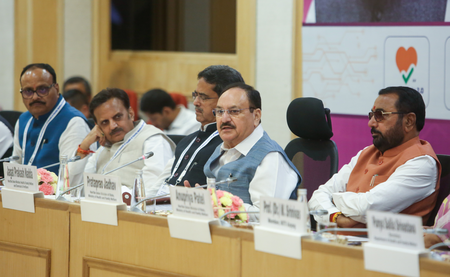
New Delhi, June 29 (IANS) Health Minister JP Nadda on Monday launched a slew of digital initiatives like ‘Ayushman Sarathi–PM-JAY WhatsApp Chatbot’ and Drug Registry, to promote efficient service delivery and improved beneficiary satisfaction.
The chatbot enables beneficiaries to access essential PM-JAY services anytime and anywhere without the need to visit government offices or call centres.
Built on secure API-based integrations with PM-JAY systems, Ayushman Sarathi delivers real-time information and services directly on WhatsApp, said the minister during an event here.
Ayushman Sarathi offers a wide range of beneficiary-centric services, including eligibility check under PM-JAY; My Ayushman Card; Apply for Ayushman Card; Download Ayushman Card; Re-do eKYC; Link Aadhaar; Lock/Unlock PM-JAY Card; Ayushman Vaya Vandana Card (70+ Years) and others.
According to health ministry, Ayushman Sarathi has been designed to improve accessibility, transparency and citizen engagement by providing instant access to PM-JAY services through WhatsApp; enabling real-time API-based service delivery; reducing dependency on physical visits and call centres; and supporting timely grievance registration and beneficiary assistance.
“The chatbot serves as an important digital interface between PM-JAY beneficiaries and the National Health Authority, promoting efficient service delivery and improved beneficiary satisfaction. The platform also supports data-driven governance by enabling feedback collection, grievance management, and continuous improvement in healthcare service delivery,” according to an official statement.
JP Nadda also launched the Drug Registry as a unified and standardised digital platform for drug-related information.
Conceptualised under the Ayushman Bharat Digital Mission (ABDM), it serves as a single source of truth for medicines in India, enabling consistent identification, storage, exchange and usage of drug data across healthcare systems.
The Drug Registry has been developed in collaboration with the Central Drugs Standard Control Organization (CDSCO) and National Resource Centre for EHR Standards (NRCeS), Pune. It leverages international standards such as SNOMED CT to ensure interoperability and semantic consistency across platforms.
Moreover, Health Minister also launched the Unified Health Interface (UHI) – the Interoperable Network for Digital Health Services.
The UHI is the service layer of ABDM, an open network with common technical standards that enables patients and healthcare providers to connect across different digital platforms, without being tied to any single application. In India’s existing digital health ecosystem, both the patient and the provider must be on the same platform to interact.
When a citizen uses a UHI-enabled app to search for a health service, the request is routed through the Gateway to registered service providers.
The entire journey from discovery and booking to fulfillment is facilitated through a common language, irrespective of the platform used to seek or provide the service.
The network uses ABDM building blocks — ABHA as the patient identifier, the Healthcare Professionals Registry (HPR) and Health Facility Registry (HFR) for provider verification, and the Health Information Exchange for consent-based data sharing.
–IANS
na/