
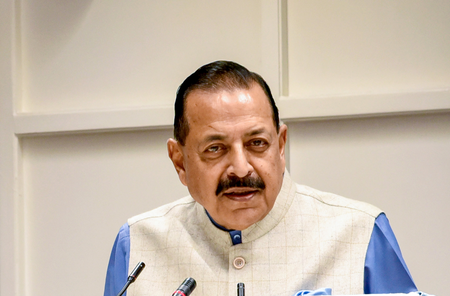
New Delhi, April 10 (IANS) Union Minister Dr Jitendra Singh on Friday congratulated Indian Space Research Organisation (ISRO) for the successful completion of the Second Integrated Air Drop Test (IADT-02) for Gaganyaan, India’s first human spaceflight mission scheduled for launch in 2027. He described the achievement as a significant milestone in preparing for the ambitious mission.
Taking to social media platform X, Singh wrote, “Congratulations ISRO for the successful accomplishment of Second Integrated Air Drop Test (IADT-02) for Gaganyaan, India’s first Human Space flight scheduled next year.”
He further noted, “The second Integrated Air Drop Test (IADT-02) was successfully conducted at Satish Dhawan Space Station, Sriharikota. This marks an important milestone towards the readiness for the Gaganyaan mission.”
India’s first human spaceflight will be launched from Sriharikota in 2027. Although the mission has faced multiple delays due to its technological complexity, India has been developing the capabilities indigenously. Notably, such critical spaceflight technologies are closely guarded, and no country shares them.
The government has allocated approximately Rs 10,000 crore for the Gaganyaan programme. The mission is now in its final phase, with the first crewed flight expected in the first quarter of 2027.
Earlier, on April 8, ISRO Chairman V. Narayanan stated that all preparations for the uncrewed Gaganyaan missions are progressing smoothly. Speaking at the inaugural session of the 2nd International Conference on Smart Spacecraft Mission Operations, he said, “We are meeting just before the first uncrewed Gaganyaan mission. This is no ordinary mission but a crucial one for India. There will be three uncrewed missions before the final crewed launch. All activities for the first mission are progressing well, though challenges remain.”
The conference was also attended by former ISRO chiefs A.S. Kiran Kumar and S. Somanath, along with ISRO centre directors, students, and representatives from space startups.
Meanwhile, India’s human spaceflight preparations advanced further on April 4, as four selected astronauts began a high-altitude experiment in Ladakh under the “Mission Mitra” (Mapping of Interoperable Traits and Reliability Assessment). The programme aims to evaluate human performance in extreme environments.
The astronauts, including Group Captain Shubhnashu Shukla and P. Balakrishnan Nair, arrived in Leh earlier this week for acclimatisation. The mission is supported by a multidisciplinary team of scientists, engineers, medical experts, and psychologists, marking another crucial step in India’s journey towards human space exploration.
–IANS
jk/dpb