

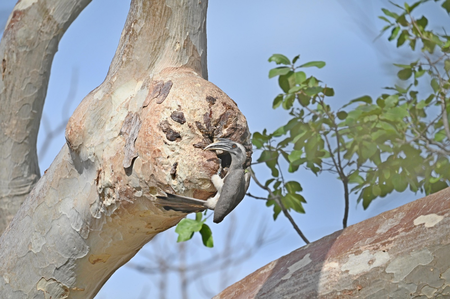
Ahmedabad, July 14 (IANS) The Indian Grey Hornbill, locally known as the Chilotro and absent from Gujarat’s Gir forests for nearly six decades, has successfully re-established itself in the landscape following a state-led reintroduction programme, with a new scientific study confirming that the birds have settled, nested and begun breeding in the wild.
The findings, published in the international peer-reviewed journal ‘Birds’ under the title ‘Reintroduction of Indian Grey Hornbills in Gir, India: Insights into Ranging, Habitat Use, Nesting and Behavioural Patterns’, provide the first comprehensive assessment of the Forest Department’s efforts, undertaken with partner institutions, to restore the species to Gir after it disappeared from the landscape in the 1950s and 1960s.
The latest development comes days after the state Forest Department reported another conservation milestone, with the second Great Indian Bustard chick produced through the ‘jump-start’ technique surviving beyond the critical 40-day period after hatching.
The Indian Grey Hornbill reintroduction project began in 2021, when birds were translocated from the Aravalli forests to Gir after scientific assessments concluded that habitat conditions had become suitable for the species.
A total of 40 hornbills were released in two phases. Twenty-eight birds were released in 2021 and 2022, followed by another 12 in 2023.
According to the study, one breeding pair successfully nested during the first year after release, while three additional breeding pairs established nests in the second year.
Researchers found that the birds are now resident in the Gir forests and breeding successfully, indicating that the reintroduction programme has achieved its primary conservation objective.
Forest and Environment Minister Arjun Modhwadia said, “Under the leadership of Chief Minister Bhupendra Patel, the Gujarat Forest Department has undertaken several important initiatives in the field of wildlife conservation. The success of projects ranging from the conservation of the critically endangered Great Indian Bustard to the reintroduction of the Indian Grey Hornbill are excellent examples of these efforts. The Chilotro was reintroduced into the Gir forests in 2021. Five years have now passed since then. The birds have settled into their new habitat and have also started breeding, demonstrating the success of the project. The successful reintroduction of the Chilotro, which disappeared from the Gir forests during the 1950s and 1960s, is a landmark achievement.”
Minister of State for Forest and Environment, Pravin Mali, said, “Gujarat’s wildlife conservation model has demonstrated to the world how natural heritage can be effectively protected and conserved. The entire country takes pride in the achievements resulting from the State Government’s dedicated wildlife conservation efforts.”
Principal Secretary of Forest and Environment Department, Vinod Rao, said the species plays an important ecological role beyond its conservation value.
“During the first year after the release of the Chilotro into the Gir forests, one pair successfully bred. In the second year, three additional breeding pairs established nests. This shows that the Chilotro has once again made Gir its home. The species plays a vital ecological role by dispersing tree seeds over long distances. This behaviour is ecologically significant because it helps in the natural regeneration of forests by dispersing the seeds of fruit-bearing trees,” he said.
Mohan Ram, Conservator of Forests, Junagadh Forest Circle, and co-author of the study, said 40 Indian Grey Hornbills were released under the project in two phases and satellite transmitters were fitted to 11 male birds to enable long-term monitoring of their movements, habitat use and breeding behaviour.
“The birds were brought from the forests of Aravalli after studies indicated that Gir once again offered suitable habitat for the species,” he said.
Principal Chief Conservator of Forests (Wildlife) and Chief Wildlife Warden Dr Jaipal Singh said habitat protection measures implemented after the declaration of the Gir Wildlife Sanctuary in 1965 and the Gir National Park in 1975 had created favourable conditions for the hornbill’s return.
“The Grey Hornbill had disappeared from Gir decades ago, but improvements in habitat protection following the declaration of the Gir Wildlife Sanctuary in 1965 and the Gir National Park in 1975 created favourable conditions for the species’ return,” he said.
Satellite tracking data showed that the released hornbills initially explored large areas of unfamiliar habitat before establishing smaller home ranges.
During the first few months after release, the birds used an average area of around 61 square km, which later reduced to approximately 5.7 square km after they became established.
Their average daily movement also declined from 4.3 km during the exploratory phase to 1.4 km after settlement, indicating successful adaptation to the Gir ecosystem.
The state government said the reintroduction forms part of broader wildlife conservation efforts in India, under which locally extinct species are being scientifically reintroduced and monitored in suitable habitats.
–IANS
mys/skp