

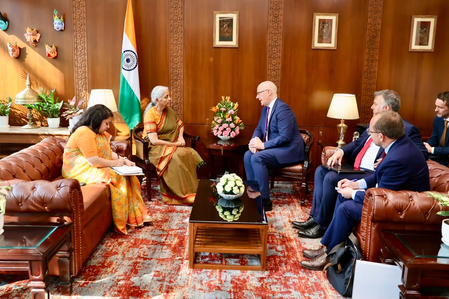
New Delhi, Oct 21 (IANS) Finance Minister Nirmala Sitharaman on Wednesday met Scotland’s First Minister John Swinney here and discussed areas of mutual interest and opportunities for strengthening cooperation in the financial services sector, among others.
They also discussed cooperation in areas like renewable energy, establishment of higher educational institutions, and enhancing bilateral tourism, according to a Finance Ministry post on X.
About three months after the India‑UK Comprehensive Economic and Trade Agreement (CETA) entered into force, the pact is already reshaping commercial ties and could deliver substantial long‑term gains for their economies.
India gains immediate export competitiveness in labour-intensive goods, deeper services integration, professional mobility relief, and a template for ambitious FTAs with other advanced economies.
The deal’s early commercial impact was visible on the first day of implementation, when Indian exporters shipped over 50 consignments worth about $140 million under zero‑duty terms.
In August, bilateral goods trade rose nearly 15 per cent year‑on‑year to nearly $2 billion, with Indian exports up about 10 per cent and UK imports into India rising faster by 24 per cent.
Bakkafrost Scotland completed the first significant shipment of Scottish salmon to India since the removal of a 33 per cent import tariff under the countries’ new free trade agreement with the UK. The salmon was flown through Heathrow Airport to Sashimi Foods in Bengaluru.
The free trade agreement (FTA) between the United Kingdom and India entered into force on July 15.
Tariff-free Scottish salmon arrived within a fortnight; Scotch whisky began clearing at the new reduced rate; and the first cars under the automotive tariff-rate quota entered India, reports said.
The India-UK FTA can help bilateral trade trajectory expand from $58 billion in 2025-26 to $115 billion by 2030, along with the possible creation of 7-10 lakh new employment opportunities, according to a recent Assocham study.
With new opportunities and deeper market access in labour-intensive industries like textiles, leather, engineering goods, pharmaceuticals, automotive, among others, employment generation and export promotion stand to gain, said the study. It further stated that for India to realise this massive potential, sustained competitiveness is crucial.
–IANS
na/vd