
United Nations, July 11 (IANS) India has called for an end to economic embargoes and sanctions, assailing them as barriers to economic and social development, and infringements on the sovereignty of nations.
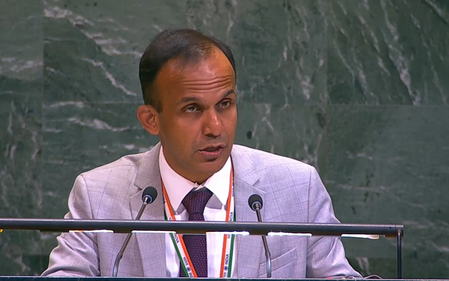
“As the world’s largest democracy, India regards multilateralism as an article of faith”, Eldos Mathew Punnoose, a counsellor at India’s Permanent Mission, told the General Assembly on Friday.
Embargoes and sanctions “impede the realisation of human rights, including the rights to development, food, education and healthcare”, he said.
“We therefore join others in calling for an end to embargoes of this nature, which constrain the full enjoyment of economic and social development by the populations of affected countries, particularly women and children”, he said.
He pointed out that the Assembly has asked all nations not to impose, and to repeal “laws and measures with extraterritorial effects that affect the sovereignty of other States”.
“Year after year, the General Assembly has rejected the imposition of laws and regulations with extraterritorial effects, as well as other forms of coercive economic measures that adversely affect the progress and prosperity of peoples around the world”, he added.
Punnoose made the statement in the context of the crippling US embargo on Cuba during what has become an annual discussion at the Assembly, leading, since 1992, to the adoption of resolutions calling for lifting it.
India, which has suffered from sanctions – most recently President Donald Trump’s secondary sanctions for buying Russian oil, which were rescinded by the US Supreme Court – has always taken a stand against countries unilaterally imposing sanctions and embargoes.
The UN Charter gives only the Security Council the power to impose embargoes and sanctions.
The unilateral embargoes like those by the US on Cuba, Punnoose said, are “in contravention of the overwhelming opinion repeatedly expressed [in the UN] and with their [US] obligations under the Charter of the United Nations and international law”.
Despite the embargo, Cuba has made important contributions to international healthcare through the deployment of its medical personnel to countries in need, and these should be recognised, he said.
“The people of Cuba have much to contribute to the international community”, and the embargo must end to enable this, he said.
After a series of sanctions against Cuba starting in 1958 with an arms embargo, the US imposed a total trade embargo in 1961, with a few exceptions for medicines and food.
While the embargo has seen some relaxation and tightening over the years, US President Donald Trump made it stringent as he pursued a maximum pressure strategy against the socialist regime.
Speaking earlier this week at the Assembly, US Permanent Representative Mike Waltz denied that there was a blockade or an embargo, citing the shiploads of aid Cuba has received from several countries.
“There is no American blockade. The only embargo in Cuba is the guillotine the regime keeps over the heads of its people”, he said.
The US itself was sending it $100 million in aid, and was working with the Catholic Church to route food and medicine to the needy, he said.
–IANS
al/rs