

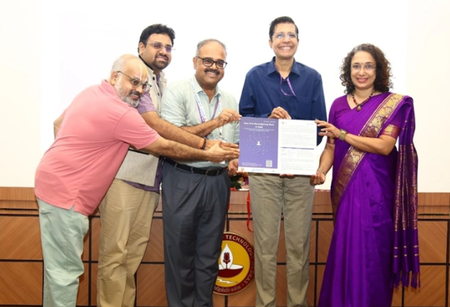
Kolkata, Oct 26 (IANS) Will AI replace jobs or reshape the future of work? A new White Paper from the Centre for Responsible AI, IIT Madras (CeRAI-IITM), offers a fresh perspective on how AI is changing employment in India.
“Public debate on AI and Indian employment tends to compress a complicated phenomenon into a single binary: Will AI take a given job, or not? This paper argues that the accurate picture is a taxonomy rather than a binary. AI rarely replaces a job wholesale; more often it automates a bundle of tasks within a job, and the size of that bundle varies with task structure, sector, regulatory setting, and, distinctively in India’s case, the economics of AI access itself,” the document states.
“We propose a four-level framework (task, job, occupation, labour-market outcome) and classify Indian job impact into two broad regimes: jobs where AI has automated most of the skill bundle and the human is reduced largely to validation, and jobs where the human remains the primary driver, and AI functions as a productivity tool. Each regime splits further into policy-relevant sub-types. Drawing on Indian evidence from business process outsourcing, manufacturing, MSMEs, sanitation, financial services, law, and software engineering, we show that every job in our sample has had to be reimagined, through task-level augmentation, task reallocation, or a genuinely new role built around operating the machine, rather than simply eliminated or defended unchanged,” the researchers have said.
The paper closes with a distributional analysis of who bears the cost of this reimagining and a three-pronged policy recommendation: continue encouraging AI diffusion, invest in India-specific labour-market research, and pair adoption with structured worker-transition pathways.
The paper set out to move beyond the simple question of “Will AI take this job?” to a more useful one: which tasks are being performed or reshaped by AI in this particular case, when does that translate into automation or displacement, and how should the job be redesigned because of it?
Across the sub-types documented, five recurring reasons emerge: cutting costs, reaching capabilities that are only possible with frontier-grade AI, meeting regulatory requirements, improving safety by removing humans from dangerous work, and fixing service quality after an earlier failed automation attempt.
“Each reason calls for a different response. Cost-driven automation needs support for workers in transition, and vigilance against over-automation. Capability-driven automation needs investment to make frontier-grade AI more affordable, not just more available. Regulation-driven automation needs clear liability rules set up in advance, rather than left to catch up after deployment. Safety-driven automation needs funding that does not hinge on cost savings. And quality-driven rollbacks need humility about how far automation can be pushed before it breaks,” the document clarifies.
According to the researchers, for India, this means employers, workers, and policymakers should stop treating every instance of “AI affecting jobs” as the same story.
“As AI moves from assistance on individual tasks towards bounded decisions and workflow-level execution, the unit of change may itself shift from the task towards the workflow; whether this ultimately displaces, augments or redesigns a job will still depend on the mechanisms identified in the paper,” they said.
The document also raises a longer-term question about the reproduction of expertise: if AI absorbs much of the entry-level work through which people historically acquire domain knowledge and judgment, how will organisations develop the next generation of human reviewers, supervisors and experts?
“Multiple AI stories are unfolding across the Indian labour market at once, and the right response depends on knowing which one is in front of you,” the researchers said.
The paper is intended as the first step in a broader programme of work on AI and employment in India. The taxonomy developed in it provides a set of hypotheses and impact pathways to be tested and refined through subsequent research, including systematic evidence reviews, sector- and work-profile analysis, and primary field research with employers and workers.
Such work can examine how widely these pathways occur, how they vary across sectors and occupations, including areas such as education and healthcare, and how the scope of AI agency interacts with the job-change mechanisms identified across sectors and occupations.
“This work will also connect with CeRAI’s ongoing research on Primers and Grounding Responsible AI principles project and the perception study with CMC, to examine how deployment, governance and public perceptions interact with changes in work. Future work in this series will also draw on CeRAI’s ongoing research on AI governance and public perceptions,” the researchers have said.
–IANS
jg/dan