
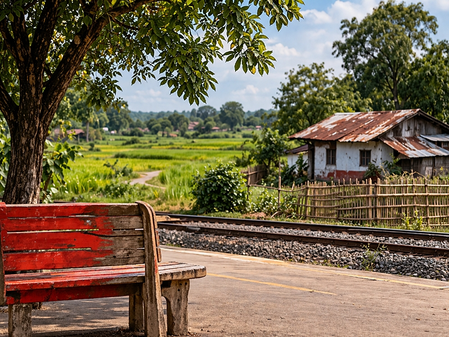
New Delhi, April 16 (IANS) The railway station still reads Naxalbari, but the far-Left movement that originated here in the late 1960s has long since lost momentum, gradually fading nearly six decades on. On the ground, times have changed — and so has the colour of politics.
The leaders behind the movement believed in the power of bullets over ballots and were therefore never tested by the people’s mandate. The period was also marked by political uncertainty in Kolkata, which saw President’s Rule imposed three times intermittently between 1968 and 1977.
Meanwhile, the Darjeeling Lok Sabha seat — of which Matigara-Naxalbari (SC) is an Assembly segment — witnessed close contests between two dominant adversaries, the Congress and the Left, barring brief intervals. In 2009, however, BJP leader Jaswant Singh wrested the Darjeeling seat with support from leaders of the Gorkhaland movement.
Since then, the BJP has retained the parliamentary constituency, with S. S. Ahluwalia winning in 2014, followed by Raju Bista in 2019 and 2024.
Matigara-Naxalbari is one of the Lok Sabha constituency’s seven Assembly segments and one of the five Assembly seats in Darjeeling district. Four of these five seats — including Matigara-Naxalbari — were won by the BJP in the 2021 Assembly elections. In the 2024 Lok Sabha polls, the party led in all these segments.
Following delimitation and the formation of the Matigara-Naxalbari Assembly constituency, Congress candidate Sankar Malakar defeated CPI-M nominee Jharen Roy by about 6,800 votes in 2011. He retained the seat in 2016, winning by a margin of over 18,600 votes against Trinamool Congress candidate Amar Sinha.
Incidentally, the Trinamool Congress came to power in 2011 in alliance with the Congress, before the two parties later parted ways. The Congress subsequently aligned with the Left.
In 2021, BJP’s Anandamoy Barman defeated Trinamool candidate Rajen Sundas by more than 70,800 votes, while Malakar finished a distant third.
In the meantime, Maoist influence waned in the area but spread elsewhere, amid internal rifts within the leadership that led to the formation of new groups and alliances.
The Naxalbari movement ignited India’s far-Left radicalism through a peasant revolt against landlords. Nearly six decades later, its birthplace has tilted towards right-wing politics, symbolising a broader political shift.
Led by radicals such as Charu Majumdar, Kanu Sanyal, and Jangal Santhal, the movement drew in tribal sharecroppers who were exploited by landlords at the time.
Expelled CPI-M radicals formed the All India Coordination Committee of Communist Revolutionaries in 1967, which later evolved into the Communist Party of India (Marxist-Leninist) in 1969 under Sanyal.
Majumdar’s shift towards urban strategy and his call for the annihilation of class enemies inspired sections of the youth, particularly university students in cities such as Kolkata.
The ideology later spread to Bihar, Andhra Pradesh, and other regions.
The aftermath and growing disillusionment were reflected in an incident on March 23, 2010, when residents of Hatighisa village near Naxalbari found Kanu Sanyal dead at his residence.
His differences with Charu Majumdar and several other party leaders were well known.
Most leaders have since abandoned armed struggle, and many among the present generation of Naxal sympathisers have joined the democratic process.
Majumdar died in July 1972 while in custody under mysterious circumstances at Alipore Central Jail in Kolkata.
Ahead of the 2006 Assembly elections, even as the Trinamool wave was building, Sanyal, speaking from his modest residence, reflected on the “excesses” committed by his comrades in earlier phases. He had also predicted that “the time is still not here for Mamata Banerjee” to win.
The Trinamool Congress indeed lost the 2006 elections despite the hype. As with many others, disillusionment with Naxal violence and shifting political bases contributed to this trend.
Now, ahead of the 2026 West Bengal Assembly polls, the BJP appears to be gaining ground amid the Left’s decline, with tribal voters increasingly prioritising development over ideology. This rightward shift underscores the erosion of far-Left influence, as economic growth and state interventions eclipse Maoist appeal.
–IANS
jb/pgh