
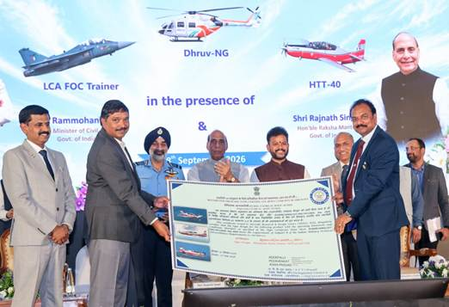
Bengaluru, Sep 18 (IANS) Government-owned aerospace giant Hindustan Aeronautics Limited (HAL) handed over two Light Combat Aircraft (LCA) Tejas final operational clearance twin-seater trainers and three HTT-40 basic trainer aircraft to the Indian Air Force (IAF), along with four Dhruv next-generation helicopters to Pawan Hans Limited, on Friday.
The platforms were displayed, and a pooja was performed in the presence of Defence Minister Rajnath Singh and Minister of Civil Aviation K. Rammohan Naidu at the handing-over ceremony.
Singh also sat inside the Dhruv next-generation (NG) chopper, which was displayed at the venue. The helicopter is a HAL-designed and manufactured 5.5-tonne, light twin-engine, multi-role helicopter.
The handover marks an important milestone in the country’s self-reliance journey, as the event highlighted the role HAL and its industry partners play in strengthening the domestic aerospace ecosystem.
The Defence Minister said combat effectiveness can be ensured only through a combination of well-trained personnel, advanced technology, integrated systems, and rapid decision-making. He said the LCA trainer will play a crucial role in preparing pilots for this demanding operational environment.
He added that while the Dhruv-NG exemplifies indigenous civil aerospace prowess, the LCA trainer stands as a symbol of indigenous military aerospace capability and the maturity of its fighter aircraft ecosystem.
Singh said India had relied for years on imported aircraft to meet its basic training requirements, but HAL is now manufacturing the HTT-40 indigenously to meet the IAF’s needs. Highlighting the aircraft’s export potential, he said the HTT-40 would find demand in international markets and fulfil its intended role in strengthening India’s aerospace capabilities.
The Defence Minister highlighted HAL’s expertise across aircraft manufacturing, helicopter development, overhaul, repair, maintenance, and aerospace engineering, calling it a pillar in India’s endeavour to build indigenous aerospace capabilities. He exhorted HAL to further expand its capabilities across the entire aerospace value chain, including design, development, manufacturing, certification, lifecycle support, and global marketing.
Singh called for realistic project timelines to address delays in ongoing technical projects. He noted that delays can create gaps in meeting critical defence requirements, lead to cost escalations, and increase the risk of technology obsolescence.
Terming R&D a crucial priority area, the Defence Minister urged young scientists, engineers, designers, test pilots, and technicians to take it as a challenge to create technologies that do not exist today. He urged them to develop capabilities that secure India’s leading position in the global aerospace technology landscape over the coming decade.
–IANS
sps/dan