
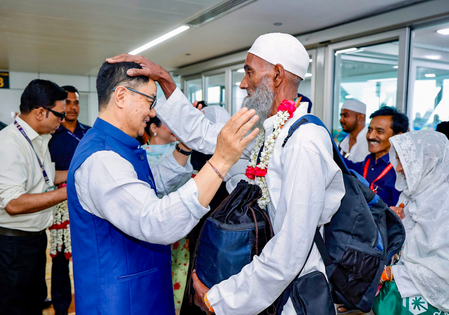
New Delhi, June 22 (IANS) The Ministry of Minority Affairs on Monday announced the Hajj Policy 2027, with Union Minister of Minority Affairs and Parliamentary Affairs Kiren Rijiju releasing the policy and declaring that the Hajj Committee of India has begun inviting applications from prospective pilgrims.
Applications for Hajj‑2027 can now be submitted online through the Hajj Committee of India portal (hajcommittee.gov.in) and the Hajj Suvidha App, a move aimed at making the process more flexible, simpler and accessible.
The quota distribution between the Hajj Committee of India and the private sector remains unchanged at 70:30, with 1,22,518 seats allocated to the Committee and 52,507 to the private sector. The Government of India has indicated that efforts will be made to increase the overall quota, which stood at 1,75,025 last year.
The announcement follows the Hajj Review Meeting chaired by Rijiju on June 18, 2026, where the conduct of Hajj‑2026 was assessed and the roadmap for Hajj‑2027 was finalised.
The Ministry emphasised that the early announcement and simultaneous opening of applications reflect its commitment to timely preparation and adherence to timelines prescribed by the Kingdom of Saudi Arabia.
Hajj Policy 2027 builds on initiatives introduced during Hajj‑2026, including sofa‑cum‑beds in Mina, high‑speed train travel between Makkah and Madinah, hotel‑style accommodation in Makkah, and the 20‑day Short Hajj Package.
The Indian Hajj Mission was recognised with two Labbaytum Awards by the Saudi Ministry of Hajj and Umrah under the “Best Hajj Coordination and Communication” category for Hajj‑2026, marking the first time India received such a distinction.
Among the key changes, the policy improves on‑ground assistance by revising the State Hajj Inspector ratio from one inspector for every 150 pilgrims to one for every 135.
To address the waiting list fairly, preference will be given to the top 20 per cent of final waitlisted applicants from Hajj‑2026. The Short Hajj Package, which saw strong demand in its first year, will continue, with Kolkata added as an embarkation point.
Medical screening will be aligned with Saudi guidelines, ensuring individuals with chronic medical conditions are not cleared to travel, prioritising the health and safety of pilgrims.
The Ministry is also pursuing artificial intelligence (AI) interventions to strengthen end‑to‑end pilgrim management. These include AI‑assisted application and document verification, demand modelling for flight allocation, and real‑time grievance tracking.
A conversational AI assistant is planned to provide round‑the‑clock support in Hindi, Urdu and major regional languages, guiding pilgrims through applications, payments, flights, accommodation, baggage, grievances and emergencies. Integration with the Saudi Nusuk platform is envisaged to ensure seamless coordination between Indian and Saudi systems.
Rijiju urged all eligible pilgrims to apply within the prescribed timelines and directed the Hajj Committee of India and concerned agencies to ensure a smooth and transparent process.
He reiterated the government’s commitment to a safe, comfortable, transparent and dignified Hajj for every Indian pilgrim.
On X, Rijiju wrote: “Today, I announced the Hajj Policy 2027 and opened applications for Hajj‑2027 through the Hajj Committee of India portal and Hajj Suvidha App. Building on the reforms of Hajj‑2026, the new policy focuses on greater comfort, safety, transparency & dignity for every pilgrim. Key measures include enhanced on‑ground support, continuation of the Short Hajj Package, strengthened medical screening & technology‑driven services, including AI‑enabled assistance in multiple Indian languages. We remain committed to making the Hajj pilgrimage more accessible, seamless and pilgrim‑centric for every Indian Hajj pilgrim.”
–IANS
scor/dan