

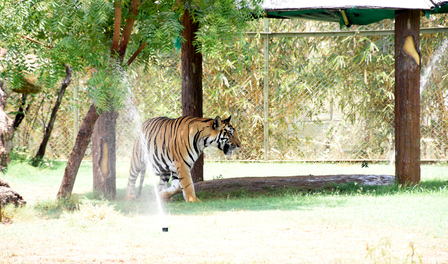
Gandhinagar, May 29 (IANS) As temperatures continue to rise across Gujarat during the ongoing summer season, the Forest Department has introduced a set of cooling and welfare measures at the Indroda Nature Park in Gandhinagar to reduce heat stress among captive and free-roaming wildlife.
The arrangements, implemented under the guidance of the state Forest and Environment Minister, Arjun Modhwadia, and Minister of State, Pravin Mali, and executed through the Gujarat Ecological Education and Research (GEER) Foundation, have been in place since April and will continue until the arrival of the monsoon.
The measures have been introduced in response to sustained high temperatures and heatwave-like conditions affecting large parts of the state.
The park currently houses more than 600 animals, including three lions, two tigers, three leopards, freshwater crocodiles, porcupines, a variety of reptiles, and several species of birds.
To manage heat conditions within enclosures, the authorities have installed 15 jumbo air coolers in carnivore enclosures and the reptile house.
These systems are operated during peak afternoon hours to help regulate internal temperatures. In addition, 20 high-pressure pop-up sprinklers have been installed across open areas of the park.
These operate between 1 P.M. and 5 P.M., creating continuous evaporative cooling to reduce ambient heat levels.
Traditional cooling methods have also been incorporated, including khus (vetiver) curtains that are regularly moistened with water.
These curtains help convert hot air into cooler airflow as it passes through the enclosures. Agro-net shading structures have also been installed to limit direct exposure to sunlight.
According to park management arrangements, the combined use of mechanical cooling, sprinklers and natural shading has helped reduce temperatures inside animal habitats by around 2 degree Celsius to 4 degree Celsius compared to external conditions, creating a controlled “microclimate” during peak summer hours.
Alongside environmental interventions, veterinary teams have revised the dietary plans of animals in accordance with seasonal requirements.
The daily food intake of carnivorous animals has been reduced by around 500 grams to 1 kilogram to prevent digestive strain during extreme heat.
Herbivorous animals and birds are being provided with water-rich fruits such as watermelon, muskmelon and cucumber to support hydration.
In addition, herbivore feed has been supplemented with vitamin C-based oral rehydration solutions and multi-mineral vitamin mixtures to help maintain electrolyte balance and reduce the risk of heat-related illness.
The park also supports a population of free-roaming wildlife, including Hanuman langurs, nilgai, peacocks and porcupines. To ensure adequate hydration for these animals, multiple water points have been established across the forest area.
These are cleaned and refilled regularly to ensure continuous access to drinking water during the summer.
For health monitoring and emergency care, veterinary services have been made available on a 24-hour basis.
Continuous surveillance is being carried out by zoo staff and veterinary professionals to monitor animal health conditions, particularly during periods of peak heat.
The measures are aimed at ensuring animal welfare and maintaining stable conditions as high summer temperatures persist across the region.
–IANS
mys/rad