
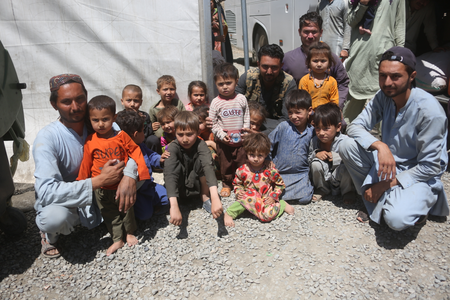
New Delhi, May 20 (IANS) Multiple international media reports, including the BBC, describe the deepening humanitarian crisis in Afghanistan, where extreme poverty is reportedly forcing families to sell their children for food, medical treatment, or relief from debt.
The reports suggest that such incidents are no longer isolated cases but part of a broader crisis in which three‑quarters of Afghans now struggle to meet even basic needs, the reports suggest.
Afghanistan’s worsening humanitarian crisis has forced families into the unthinkable act of selling their children, often daughters, to survive. These media reports highlight extreme poverty, hunger, unemployment, and cuts in international aid as the main drivers, compounded by Taliban restrictions on women and girls.
This week’s BBC report from Ghor province showed multiple families driven by extreme hunger and unemployment to sell their daughters, with one father, Saeed Ahmad, saying he was forced to sell his five-year-old Shaiqa for her lifesaving surgery on a liver cyst and appendicitis. His condition, the buyer could take her away only after the required medical treatment was over. Shaiqa’s surgery was successful. The expense was met by the money that came from the 200,000 Afghani (less than USD 3,200) she has been sold for.
The report stressed that three out of four Afghans cannot meet their basic needs, with emergency‑level hunger affecting almost five million people and child deaths rising due to malnutrition and collapsed health services.
Unemployment is rife, healthcare is struggling, and the aid that once provided the basics for millions has dwindled to a fraction of what it once was, it added. Families in Ghor, the news network found, are selling children to overcome hunger and unemployment.
UN data reportedly shows that three in four Afghans cannot meet basic needs. Parents describe selling children as the only way to prevent starvation. A distressed father, introducing two of his children – seven-year-old twins, namely Roqia and Rohila – told the British public broadcaster that he is even willing to sell his daughters being so poor, in debt, and helpless.
Earlier reports have documented parents saying they sold children because “the other children were dying of hunger,” highlighting this as a pattern rather than a one‑off atrocity. A 2022 VOA programme “In Afghanistan, Selling One Child to Save Another” documented the same year how parents in drought‑stricken areas sell one child to prevent the rest of the family from starving, underlining the arithmetic of survival in the rural parts.
The same year, Britain’s ITV News reported that “desperate families are driven by starvation to try to sell their own children”, with footage of emaciated babies dying in hospitals due to lack of medicines and food. It found a mother, with her children laid out in the local market “like goods for sale”.
Germany’s Deutsche Welle (DW) ran a feature “Child trafficking in Afghanistan”, documenting how internally displaced families in rural provinces are forced into child‑selling networks, often mediated by brokers or relatives.
Australia’s SBS News reported in 2021 about an Afghan mother who sold one of her newborn twins to a childless couple to stave off starvation for the rest of her family, a case that went viral globally as a symbol of the country’s humanitarian collapse.
Data from the UN and other NGOs cited by BBC and others show that over 80 per cent of Afghan households are in debt, while unemployment, climate‑related droughts, and the collapse of a foreign‑aid‑dependent economy have left 23–30 million people in acute food insecurity.
Commentators note that the crisis has deepened since the Taliban’s return to power and the suspension of much international aid, creating a situation where “abject poverty” is now the norm for vast swathes of the population, not an exception.
“Estimates indicate that around 28 million people in Afghanistan were living in poverty in 2025, with the situation compounded by mass population returns, worsening drought and shrinking international aid,” noted a recent report from the UN.
“While Afghanistan recorded a second consecutive year of economic growth, real GDP expanded by just 1.9 per cent in 2025, down from 2.3 per cent the previous year. Population growth, however, reached 6.5 per cent, resulting in an estimated 2.1 per cent decline in real GDP per capita,” it added.
–IANS
jb/snj