
Washington, Nov 6 (IANS) Before Amish Shah and Jay Feely faced each other in an Arizona congressional election, they worked on the same football field. Shah was a physician on the New York Jets’ sidelines. Feely was the team’s kicker.
Their political contest ended on Thursday with Shah winning a seat in the US House, completing a comeback from his 2024 defeat.
The Indian-American emergency physician defeated the Trump-backed Republican in Arizona’s 1st Congressional District, a Scottsdale-area seat President Donald Trump carried by about 3 percentage points in 2024. Republican Rep. David Schweikert left the seat to run for governor.
“I pledge to work in a bipartisan way in Congress, just like I did in the State House,” Shah said in his victory statement.
Indian American Impact, an advocacy organisation that supported him, said he would become the first South Asian American to represent Arizona in Congress.
Shah campaigned as a physician concerned with household costs and access to care. His record includes support for expanded government health coverage.
The roots of that political identity stretch from Chicago to Gujarat, through New York hospitals and the Arizona Legislature.
Shah was born and raised in Chicago, the son of engineering students who immigrated from India. His father is Jain, and his mother is Hindu. He attended Catholic school from kindergarten through high school.
His parents arrived in the United States in 1969 and took him to India regularly to maintain the family’s connections with Gujarat.
He described his Jain upbringing as an influence on his politics, emphasising nonviolence, nonmaterialism and openness to different perspectives.
“I feel that the philosophy which I have been taught early at Jain temples and conferences is something that I have been able to bring to my politics too,” he told an Indian publication in 2023.
A visit to Mahatma Gandhi’s Sabarmati Ashram helped shape his interest in public service.
“Gandhiji’s message had a big impact on me before I first ran for office,” he said.
Medicine came first. Shah earned economics and medical degrees at Northwestern University, worked in management consulting and completed a master’s degree in public health at the University of California, Berkeley.
He trained in emergency medicine at Lincoln Hospital in the Bronx and later worked at Mount Sinai in Manhattan and Elmhurst Hospital in Queens. At Mount Sinai, his responsibilities included leading the Jets’ airway management team and conducting research on emergency care in professional football.
He subsequently completed a sports medicine fellowship at the University of Arizona.
Away from medicine, his official legislative biography describes a Gujarati speaker who also knows conversational Spanish, flies small aeroplanes, and founded the Arizona Vegetarian Food Festival. It also lists three adopted cats — a personal interest reflected in his later animal-welfare proposals.
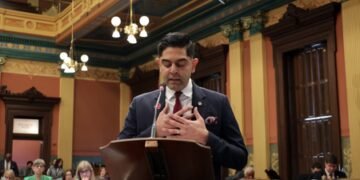
Shah won election to the Arizona House in 2018 and was reelected in 2020 and 2022. As a Democrat in the minority, he sought Republican partners to move legislation.
His record includes measures that passed and others that stalled. A 2022 proposal to ban cat declawing did not become law. He co-sponsored an overnight fireworks restriction introduced by Republican Sen. J.D. Mesnard and an animal microchip-scanning measure introduced by Republican Rep. John Kavanagh. Both became law.
Those distinctions matter in assessing his legislative record: Shah helped advance the measures, but was not their principal author.
Public safety also became part of his appeal beyond Democratic voters. During the congressional campaign, the Maricopa County deputies’ association endorsed him over Feely, citing his support for officers’ resources.
Axios reported that Shah had crossed party lines on law enforcement legislation, including a fentanyl measure. The endorsement complicated Republican efforts to portray him as hostile to police, although Axios also reported that he offered limited detail when asked about two police accountability issues.
Health care exposed a different tension in his political positioning.
Phoenix New Times reported that Shah backed universal, single-payer Medicare for All at a 2019 event associated with Bernie Sanders’ presidential campaign. More recently, he has advocated a Medicare buy-in, allowing people to purchase coverage through the federal programme.
He told The Copper Courier that such an option would “cause some downward price pressure in the market.”
Feely used Shah’s past associations to portray him as a socialist. Phoenix’s Democratic Socialists of America chapter rejected that characterisation.
“Amish Shah is not a member of the DSA, has never been a member of the DSA,” chapter co-chair Emily Kirkland told Phoenix New Times. “He’s a moderate.”
Shah resigned from the Arizona House in early 2024 to run for Congress, then narrowly lost to Schweikert that November.
His second attempt required another fight within his own party. The Democratic Congressional Campaign Committee endorsed former television journalist Marlene Galan-Woods in the primary. Shah defeated her, and the committee subsequently backed him in the general election.
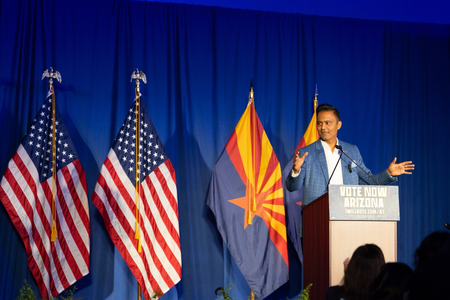
“I wasn’t exactly my party’s pick,” Shah told supporters on primary night. “And I was willing to stand up to that establishment. And that’s what the voters of this district want.”
The campaign against Feely drew more than $25 million in outside spending after the primary. About $16 million supported Feely, much of it through advertisements attacking Shah, compared with roughly $9 million supporting Shah, KTAR reported.
Shah focused on affordability while attacking Feely’s alignment with Trump. In a September interview with The Copper Courier, he advocated reversing Trump’s tariffs, arguing that unpredictable trade policy made it harder for businesses to invest. He also called for ending the Iran war, saying it was pushing gasoline prices higher.
His Indian heritage informed his interest in immigration. He has supported bringing skilled Indian workers to the United States and expressed interest in comprehensive immigration reform.
After the election, Shah returned to the concerns that had anchored his campaign: living costs, health coverage, water and economic growth. He promised to represent constituents whether or not they had supported him.
“I will try my best to keep that trust sacred,” he told KTAR on Thursday.
The new Congress convenes on January 3. Shah will arrive having defeated both his party leadership’s preferred candidate and a Republican backed by the President. His next challenge will be to turn the independence he emphasised on the campaign trail into legislation that serves a politically divided district.
–IANS
lkj/ksk/uk