
New Delhi, April 10 (IANS) Around 32 days after their AFC Women’s Asian Cup campaign drew to a painful end, the Indian women’s national team will begin a new chapter with renewed vigour at the FIFA Series 2026 Kenya. The Blue Tigresses will face the hosts in their opening game at the Nyayo National Stadium in Nairobi, Kenya, on Saturday.
The disappointment of missing out on the knockout stage hasn’t fully buried yet for the players, but they are well aware that the end of one chapter is the beginning of the next, and that’s the main motivation ahead of the four-team friendly tournament.
Crispin Chettri, who is once again at the helm of affairs as the head coach of the Blue Tigresses, stressed, “The idea is to start building for the future already. For the next AFC Women’s Asian Cup 2029 qualifiers and the 2031 World Cup qualifiers. We have to begin now.”
Chettri led India to qualification for the Asian Cup last year and was an assistant to Amelia Valverde during the final tournament. “I think the expectation from everyone was that we should at least reach the quarter-finals from the group stage. Even the players had that expectation, so I think they are a little low at the moment,” said Chettri.
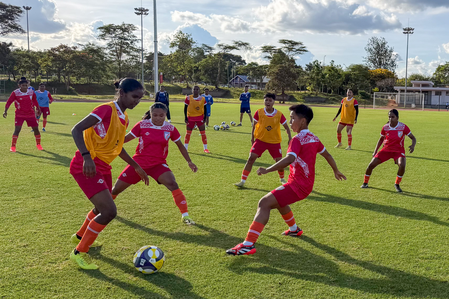
India arrived in Nairobi on April 7, and have had two training sessions so far, with another to go on Friday before the game against the hosts. “Mentally, the players are much more prepared now. When they take to the training pitch, they are only focused on preparing for the next game,” Chettri added.
The conditions have also aided the team’s early preparations. “Yes, the training conditions are good. The weather is really pleasant, around 26 to 27 degrees. It is very good weather to train in,” said Chettri, reflecting on the first two sessions in Kenya.
The FIFA Series, featuring India, hosts Kenya, Malawi, and Australia, offers a compact competitive structure despite being a friendly tournament. India will face Kenya in the second semi-final, while Australia take on Malawi in the first at 16:30 IST. The winners will meet in the final, and the losing teams will contest the third-place play-off on April 15. It is the first time the Indian women’s national team will play a match in Africa.
Beyond results, the tournament also serves a clear strategic purpose, which is preparation for the SAFF Women’s Championship 2026, set to be held in Goa from May 25. Squad selection has therefore been shaped with both immediate readiness and long-term development in mind.
Chettri has opted for a younger, evolving group, with several senior players unavailable due to injury and rehabilitation. The average age of the 22-member travelling squad to Kenya is only 22.8 years. From the 26 players who were part of the Asian Cup, 17 were picked by Chettri for the current window. Among the rest, goalkeeper Panthoi Chanu Elangbam and defender Sweety Devi Ngangbam are recovering after suffering from injuries in the last Asian Cup game against Chinese Taipei, while defender Sanju, midfielder Sangita Basfore, and forwards Grace Dangmei and Soumya Guguloth have been rested.
Meanwhile, attacker Manisha, who had signed for Liga Femenina FPF (Peruvian Women’s League) club Alianza Lima earlier this year, has also been given time. Chettri said, “Since her (Manisha’s) league in Peru has started, I advised her to stay there and focus on breaking into the starting XI (at her club Alianza Lima). She has had a busy schedule with a lot of travel, so more time with her club will help her,” Chettri explained.
The absence of established names has opened the door for emerging talent, aligning with Chettri’s broader vision of expanding India’s player base as they begin preparations for the next cycle of qualification. The 2026 Asian Cup was the last to offer World Cup-qualifying slots. For the 2031 edition, AFC will organise a standalone qualifying tournament for the World Cup, broadening the scope of competitive matches for women’s national teams on the continent.
“We know what the senior players can do, so this was a good opportunity to look at younger players like Kaviya Pakkirisamy, Jasoda Munda, and Malavika P, among others. Most of our players are in the 22-23 age bracket, so they can serve the national team for the next six to seven years at least. We want to build a larger pool of around 40 competitive players, including talents from the U20 and U17 teams.
“That is why we have brought in more junior players, to create a system, give them exposure, and prepare properly for the SAFF Women’s Championship.
“We also had only three days of training before the first game, so I needed fit players. Many players are coming from clubs like Sethu, Sribhumi, and East Bengal, who are actively training. Also, players from police teams are with us, as the Police meet (B.N. Mullick Memorial All India Police Football Championship) took place recently in Hyderabad.”
On the pitch, India are preparing for a different kind of challenge. Unlike the technical and tactical demands posed by most East and Southeast Asian opponents, Kenya brings a more physical dimension to the game.
“The FIFA Series will test our physical abilities. Teams like Kenya and Malawi may be lower in FIFA rankings (134th and 153rd), but rankings can be misleading. Kenya, for example, has players playing in the USA and Europe,” said Chettri.
“They are quick, strong, and very physical. It will be a different challenge compared to teams like Japan, Korea, Thailand, or Vietnam, whom we’ve played within the last year. Our job is to handle that physicality. It will be an interesting match-up. And if we win, we may get to face Australia, who were finalists at the Asian Cup. So this is a great opportunity.”
“We qualified for the Asian Cup after a long time, and we want to make that a habit. SAFF can serve as preparation for future Asian Cup and World Cup qualifiers. In the short term, we need to improve our ranking by winning matches. That will help us get better positions in the pots and relatively easier opponents in qualifiers.”
Integral to that long-term vision is the integration of youth players into the senior setup. Chettri closely followed the AFC U20 Women’s Asian Cup, where India finished their campaign with a win over Chinese Taipei on Wednesday. The Young Tigresses head coach opined that many of his U20 players may soon be knocking on the doors of the senior team.
“I think Joakim is right. Before the Asian Cup qualifiers last year, when we were in Bengaluru, we were in constant communication about the U20 players. We even used many junior players – like Shubhangi (Singh), Thoibisana (Chanu Toijam), Cindy (Colney), and Sulanjana (Raul) – in the preparation camp, and Monalisha (Devi Moirangthem) was already part of the senior team.
“There are several promising players not just in the U20s, but also in the U17s. From the U20 group, I believe three to four players will soon challenge for places, not just in the squad, but even in the starting XI.”
As India step onto the pitch in Nairobi, the objective apart from getting results will be to recalibrate, test depth, and lay the groundwork for a cycle that leads through the SAFF Championship, Asian Cup, and World Cup qualifiers.
–IANS
bsk/