
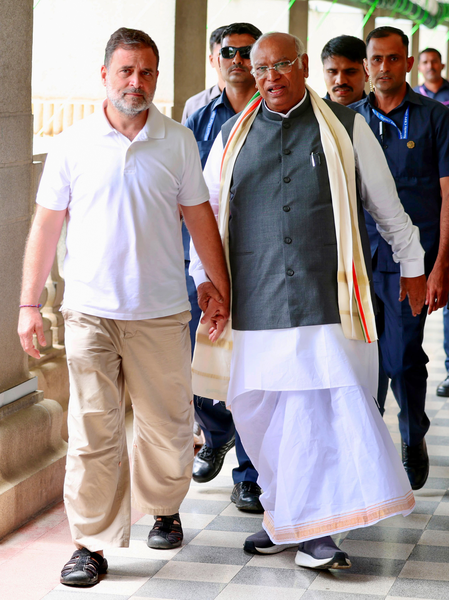
New Delhi, June 7 (IANS) When historian Ramachandra Guha remarked that he did not believe Congress leader Rahul Gandhi was equipped to handle major national challenges such as an energy crisis or a war, he gave voice to a question that has lingered in Indian politics for years.
The significance of the observation lay less in the remark itself and more in who made it. Guha is hardly known for being sympathetic to Prime Minister Narendra Modi or the BJP. His criticism of the government has been consistent and often unsparing. Therefore, when someone from outside the BJP’s political ecosystem raises doubts about the Opposition’s leadership credentials, the comment inevitably carries greater weight.
The debate is about Rahul Gandhi and the larger condition of India’s Opposition and its ability to present itself as a credible alternative government.
Over the past decade, the Modi government has faced a succession of challenges, from the Covid-19 pandemic and border tensions to economic disruptions and global geopolitical shocks. Supporters of the government argue that despite criticism and setbacks, it has managed to retain public confidence. Critics may disagree with many of its decisions, but there is little doubt that PM Modi continues to enjoy a level of political trust that no other contemporary leader can match.
That reality poses a difficult question for the Opposition. If large sections of the electorate continue to back the ruling leadership despite economic pressures and periodic crises, where exactly is the Opposition falling short?
Many voters may be dissatisfied with specific policies, rising prices, or local governance issues, but they do not necessarily see a convincing national alternative waiting in the wings. Elections are not decided merely by dissatisfaction with incumbents; they are also determined by confidence in those seeking to replace them.
This is where the Rahul-led Opposition appears to struggle. Too often, its politics seems driven by opposition for its own sake rather than by a clearly articulated vision of governance. Personal attacks on PM Modi frequently generate headlines, but headlines alone do not build public confidence. Voters eventually look beyond slogans and ask a simpler question: if not the present government, then who, and with what plan?
Recent political developments illustrate this challenge. Across different states, voters have displayed a remarkable willingness to make independent choices based on local realities rather than broad national narratives. State-specific factors, anti-incumbency sentiments, and regional dynamics often shape electoral outcomes. Despite these fluctuations, the Opposition has found it difficult to translate episodic discontent into a sustained national political movement.
The problem is not a shortage of issues. Inflation, unemployment, agrarian distress, and social tensions provide ample political ammunition. The challenge is converting criticism into credibility.
That is why many of the movements and campaigns that were projected as major turning points against the BJP have ultimately failed to produce the political consequences their supporters anticipated. The protests against the Citizenship Amendment Act, the agitation over farm laws, the wrestlers’ protest and several social media-driven campaigns generated enormous attention and, in some cases, forced the government to respond. But they did not fundamentally alter the BJP’s electoral dominance.
There is criticism of the government, but there is no corresponding confidence in the Opposition. The space for a strong national challenger exists, but no political force has been able to occupy it convincingly.
The emergence of groups seeking to fill this vacuum is therefore not surprising. Some gain visibility on social media; others capture public attention for a brief period, and a few even generate excitement among anti-establishment voters. Indian politics has repeatedly demonstrated that public attention and electoral success are not the same thing.
Even the Aam Aadmi Party, once seen as the most serious challenger to the traditional political order, has found the transition from movement politics to long-term national expansion far more difficult than expected. The lesson is simple: discontent alone cannot sustain a political alternative. Leadership, organisation, credibility, and a coherent vision matter just as much.
Seen in that context, Guha’s remarks acquire significance. They revive an uncomfortable question for the Congress leadership: has it done enough to convince voters that it is prepared to govern during moments of national difficulty?
The issue is not whether Rahul Gandhi has the right to criticise the Prime Minister. In a democracy, criticism of those in power is both legitimate and necessary. The real issue is whether that criticism is accompanied by an alternative vision. Oppositions do not earn public trust merely by highlighting the government’s failures; they earn it by demonstrating their own readiness to govern.
The irony is that the constitutional book that Rahul Gandhi frequently flashes places enormous importance on the role of the Opposition. Dr B.R. Ambedkar regarded a vigilant Opposition as essential for democratic accountability. Similarly, former Prime Minister Atal Bihari Vajpayee believed that criticism was most effective when it was rooted in policy, principle, and national interest rather than personal hostility. But today, is the Rahul Gandhi-led Opposition doing so?
The real challenge before the Rahul Gandhi-led Opposition, therefore, is not finding a sharper slogan against PM Modi or a more effective political attack. It is building the kind of responsible, persuasive, and credible Opposition that can convince voters it is ready for power. Until that happens, observations such as Guha’s will continue to resonate because many voters see them as reflecting a political reality.
(Deepika Bhan can be contacted at deepika.b@ians.in)
–IANS
dpb/sd/