
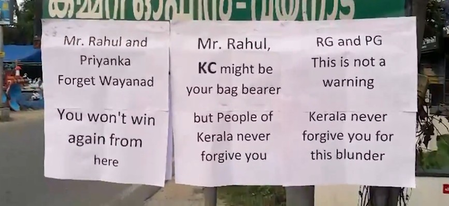
New Delhi, May 17 (IANS) ‘Kerala will never forgive you’ — the posters are likely to haunt the Gandhi siblings for a long time. These were not ordinary political posters meant to mock a leader or score a point. They were a bitter reflection of the kind of politics the Congress high command has increasingly found itself engaged in.
The posters mysteriously appeared in Wayanad, targeting Rahul Gandhi and Priyanka Gandhi Vadra over the Congress leadership’s inability to decide between K.C. Venugopal and V.D. Satheesan for the post of Kerala Chief Minister.
Wayanad is no ordinary constituency for the Gandhis. It is the seat from where Priyanka Gandhi Vadra registered her first Lok Sabha victory, and before that, Rahul Gandhi won twice with commanding margins. The constituency has long been considered politically safe for the family, given its demographic composition — around 21.5 per cent Christians, 28.8 per cent Muslims, and nearly 49 per cent Hindus — with minority communities largely backing the Congress.
The electorate has overwhelmingly voted for the Gandhis. Priyanka Gandhi Vadra won the November 2024 bypoll by a margin of 4,10,931 votes, surpassing the 3,64,422-vote margin with which Rahul Gandhi won the seat in the 2024 Lok Sabha elections. In 2019, Rahul Gandhi’s winning margin stood at 4,31,770 votes. Vadra secured nearly 65 per cent of the votes polled, while BJP candidate Navya Haridas received a little over 11 per cent.
So, when posters surfaced openly threatening the Gandhi siblings politically, the message had the effect, presumably. Soon after, the Congress leadership moved towards a decision on the Kerala Chief Minister.
The BJP was quick to describe the development as a decision taken under pressure. While the party itself has limited stakes in Kerala, the charge echoed a perception that had already begun to circulate.
The 2026 Kerala Assembly election also reinforced perceptions that the Indian Union Muslim League (IUML) has emerged as an unusually influential force within the United Democratic Front (UDF), despite the Congress winning 63 seats. The Congress party may have secured the largest number of seats in the UDF, but coalition realities meant it could not easily ignore the preferences of its second-largest ally.
In the high-stakes 2026 Assembly elections across four states and one union territory, national attention remained largely fixed on West Bengal. As a result, developments in Assam, Tamil Nadu, and Kerala did not receive the same scrutiny.
One striking feature of these elections has been the growing prominence of identity-based political mobilisation in several states, including the consolidation of Muslim political blocs in places like Assam and Kerala, and their evolving relationship with the Congress party.
Of the 19 Congress candidates who won in Assam, 18 are Muslims. In West Bengal, too, both newly elected Congress MLAs are Muslims. In Kerala, the IUML registered one of its strongest performances with 22 seats, placing itself in a position where it could significantly influence the Congress leadership’s decisions.
The increasing consolidation of community-based political influence in state Assemblies may eventually shape parliamentary politics as well. This is part of democratic representation, no doubt, but it is a trend that could deepen identity-driven politics. India’s political history offers enough examples to keep such concerns alive.
One of the most cited examples from post-Independence India remains the Shah Bano case. Several Muslim organisations, including the IUML, had opposed the Supreme Court verdict granting maintenance rights to Shah Bano, eventually pressuring the Rajiv Gandhi government to overturn the judgment legislatively. The episode continues to be seen as a defining moment in India’s debate over appeasement politics.
Over the years, organisations like the IUML have also opposed measures such as the criminalisation of instant triple talaq, the Citizenship Amendment Act (CAA), and the Waqf Amendment Act.
In a democracy, minorities have every right to political representation and to voice their concerns. But religion-based consolidation in politics has carried historical consequences as well. This politics has historically remained a sensitive subject in India because of the Partition experience and the deep communal scars it left behind. In 1947, the All-India Muslim League under Muhammad Ali Jinnah spearheaded the movement that led to the creation of Pakistan.
After Partition, the original Muslim League ceased to exist in India, but the Indian Union Muslim League was formed in 1948 and gradually established itself as a significant political force in Kerala. Some of its early leaders had roots in the pre-Partition Muslim League.
The Congress party’s alliance with the IUML has often drawn criticism from opponents, despite describing itself as a secular party and the BJP as communal. Political arrangements exist between regional parties and influential Muslim groupings in several states. Parties have often reduced communities into electoral blocs, rather than treating them as broader participants in governance.
It was against this backdrop that the Wayanad posters triggered alarm within the Congress party. The language was unusually direct. One poster read, “Mr Rahul and Priyanka, forget Wayanad. You won’t win again from here.” Another declared, “This is not a warning. Kerala will never forgive you for this blunder.” A third said, “Mr Rahul, KC might be your bag bearer, but the people of Kerala will never forgive you.”
Who put up these posters may never be conclusively known. But they appear to have had the intended political effect. Rahul Gandhi eventually backed Satheesan, who was widely believed to be the preferred choice of the IUML leadership. Congress may insist that the decision reflected feedback from grassroots workers, but the perception of pressure remains difficult to dismiss entirely.
What unfolded in Kerala may be interpreted as the compulsions of coalition politics. It has also revived a larger debate over whether Congress is becoming increasingly dependent on identity-based political alignments. Assam’s AIUDF chief Badruddin Ajmal has even remarked that Congress is turning into a “Muslim League”.
Nearly seven decades ago, Rahul Gandhi’s great-grandfather and India’s first Prime Minister, Jawaharlal Nehru, had openly criticised the IUML, describing it as a communal organisation. During an election speech in Kozhikode in 1957, he had referred to the Muslim League as a “dead horse”, and also remarked that while the Muslim League had gone to Pakistan after Partition, “a little bit of its tail” had remained behind in Malabar.
What Jawaharlal Nehru once described as communal is today defended by many within the Congress party as part of secular coalition politics. And perhaps, in the sharp language of those Wayanad posters, the Gandhi siblings got a glimpse of the consequences of indulging in such loaded politics.
(Deepika Bhan can be contacted at deepika.b@ians.in)
–IANS
dpb/sd/