
Stanford (California), April 17 (IANS) Rashtriya Swayamsevak Sangh General Secretary Dattatreya Hosabale on Friday told a Silicon Valley gathering that scientific progress must be guided by ethics and equality, warning that unchecked technological growth could deepen social divides.
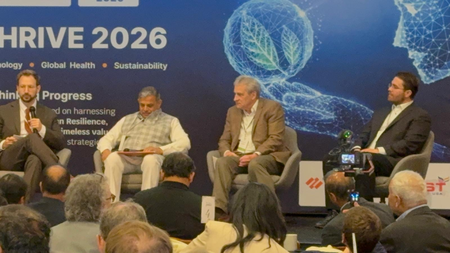
Speaking at the Thrive 2026 conference at the prestigious Stanford University, Hosabale said India’s civilisational knowledge systems treat science and spirituality as interconnected.
He said he had come “to share some knowledge of my civilisation…, and also learn something from across the world.”
He described Indian traditions as rooted in both empirical and transcendental inquiry.
“The roots have been sensory and super sensory, the culture, perception and reasoning based, but also that we see beyond the limits of human knowledge,” he said.
“There is no segregation between the spiritual and the secular in spiritual knowledge.”
Hosabale said ancient systems such as yoga reflected scientific study of “human anatomy, mind sciences, human body, action, and inaction,” adding that “everything is science” in that framework.
He said India’s scientific traditions had been disrupted over centuries. “Over a period of time, because of continuous invasion… the traditions were destroyed,” he said, adding that foreign rule led to a loss of awareness of indigenous knowledge. He pointed to recent policy efforts to revive these systems, saying “the Indian knowledge system is being revived.”
Hosabale described early Indian inquiry as deeply cosmological. “It is full of cosmic inquiry,” he said, referring to traditions that explored “the relation between the microcosm and macrocosm.”
He also cited examples of early advances in “town planning, university survey, and a lot of civil engineering.”
He warned that rapid technological growth could widen inequality if not carefully managed.
“Where technology advances, the society tends to become more unequal,” he said. He linked disparities in access to education with broader gaps in “economic growth, education, quality of life.”
He said governments must take a balanced approach.
“The governance today has to take into consideration these very cities,” he said, urging policymakers to address both innovation and social impact.
Hosabale stressed the role of education in preserving scientific temper. If traditional knowledge is not properly understood, he said, “all those scientific inquiries, the past will be concluded as only superstitions.”
He called it a challenge “to find a real scientific thing” within inherited traditions and integrate it into curricula.
He also outlined a philosophical approach to nature and technology.
“We are all part of the same one source of energy,” he said, arguing that this view encourages respect for nature rather than exploitation.
He proposed a three-part test for technology: “economy, equality and ethics.” Technologies that harm social balance, exploit nature or lack ethical grounding should be reconsidered, he said.
The session, organised by the Global Science Innovation Forum, brought together scholars and technologists to discuss the intersection of science, ethics and civilisational knowledge systems.
–IANS
lkj/dan