
New Delhi, Nov 20 (IANS) For Indian security agencies, Punjab remains the biggest challenge in tackling narcotics smuggling, with a sharp and unprecedented rise in smuggling incidents, particularly those involving the use of drones.
While security agencies are grappling with the problem in Punjab, narcotics smugglers are increasingly looking to expand their operations on a large scale in Rajasthan. The state police have identified 28 handlers operating from Pakistan who are allegedly overseeing narcotics smuggling networks in Rajasthan.
An Intelligence Bureau official said Punjab would continue to remain the primary hub for narcotics smuggling, while Rajasthan was emerging as a secondary destination for such activities.
“Drug cartels have been focusing heavily on Rajasthan since 2024 and are looking to establish an alternative base to Punjab for pushing narcotics into India,” the official said.
There is, however, a huge difference if one looks at the statistics relating to drone-based narcotic and arms and ammunition smuggling in the two states. Punjab accounts for 98 per cent of drone-linked drug cases as opposed to the 5 per cent in Rajasthan.
An official said that in Punjab, drone-linked smuggling has been taking place for several years now. The state, in fact, accounted for 298 of India’s 305 drone-based drug trafficking cases. This means Punjab accounts for a whopping 98 per cent of drone-based drug trafficking cases in India.
To tackle the drug menace in Punjab, security agencies have strengthened surveillance mechanisms and stepped up the deployment of anti-drone jammers and forensic tracking systems. However, whenever security pressure intensifies in Punjab, narcotics cartels shift their operations to Rajasthan, which is increasingly emerging as their secondary hub.
Interestingly, the networks operating in both states are interconnected and are believed to be part of the same smuggling syndicate.
Several suspects arrested in Sri Ganganagar and Bikaner were found to be residents of Punjab, pointing to the links between drug trafficking networks operating in the two states.
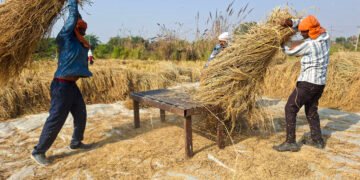
“These individuals have been deployed in both states to collect narcotics from designated dead-drop locations. In Rajasthan, traffickers drop drug consignments in fields that are relatively less monitored, after which the payloads are transported by road. These cartels have also recruited a large number of youths from Punjab to carry out operations in both states,” the official said.
Another official said the networks overseeing narcotics smuggling operations in Punjab and Rajasthan were the same, with the youth recruited to collect and transport drug consignments in both states operating under a common command structure.
“The cartels prefer to recruit fewer youths in Rajasthan than in Punjab as they want to keep their operations tightly controlled,” the official said.
The Rajasthan police and central agencies have taken note of the issue and are going all out to ensure that the problem does not escalate on a scale similar to Punjab. A full-fledged drive has been undertaken to identify specific fields which are used to drop narcotics, arms, and ammunition.
In another significant development, authorities are considering strict action against landowners who allow their fields to be used as drop-off points for narcotics consignments. If found complicit in the smuggling operations, such landowners could face the acquisition of their fields by the government, rendering the properties government-owned.
Officials said narcotics cartels were anticipating intensified action against their networks in Punjab in the coming days and were consequently working to establish an alternative operational base in Rajasthan. This would allow them to continue smuggling activities without disruption even if operations in Punjab were significantly curtailed.
The drug menace in Punjab has reached alarming proportions. Official data shows that only three incidents of drug smuggling involving drones were reported in 2021. By 2025, the number had surged to 305, highlighting the growing use of drones by narcotics traffickers.
This cannot go on for long, and eventually the agencies will get the better of the drug cartels. These narcotic smugglers are preparing an alternate ground to drop off drugs and keep the ship sailing in case operations fail in Punjab, an official said.
–IANS
vn/srk/skp