
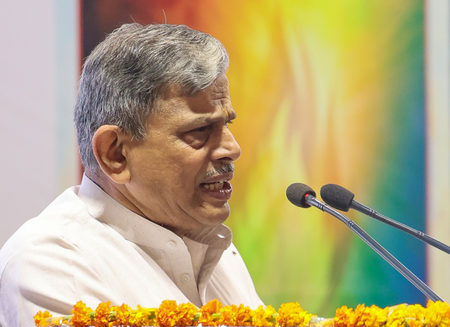
Stanford, April 18 (IANS) The Rashtriya Swayamsevak Sangh has articulated a clear framework for the Indian diaspora, with its General Secretary Dattatreya Hosabale saying that Indians living abroad must place “allegiance to the nation where they are living” above all else, even as they remain culturally connected to India.
In an interview marking 100 years of the RSS, Hosabale said the organisation’s overseas engagement is guided by a dual approach — integration with local societies and continued civilisational linkage with India.
“Swayamsevaks… in different countries… have also tried to see that the local Hindu community is organised,” he said, adding that their role extends beyond community bonding to broader societal contribution.
“Their allegiance to the nation where they are living, their loyalty to that country, and also contributing for the betterment and welfare of that society and country is the first thing,” Hosabale said.
He said this principle reflects a conscious effort to ensure that diaspora communities remain responsible citizens in their adopted countries, while maintaining cultural roots.
“At the same time… because of the cultural affinity… they are also serving… Bharat being miles away from the motherland,” he said.
Hosabale framed this approach within the broader philosophical idea of Vasudhaiva Kutumbakam — the world as one family — which he described as central to the RSS worldview.
“This message… world is one family… is ingrained… it is not just a slogan, but it is practiced,” he said, linking it to everyday conduct and social activity.
He said this philosophy enables individuals to view people across nations as part of a shared human community, reducing conflict and fostering cooperation.
The RSS leader also pointed to India’s recent global messaging, including the “one earth, one family, one future” theme, as reflecting the same underlying civilisational outlook.
Expanding on the global dimension, Hosabale said the RSS envisions a role for Indian cultural values in addressing contemporary international challenges, including geopolitical tensions, religious conflict and social fragmentation.
“Today’s world is also passing through very critical times,” he said, citing “hegemony”, “violence in the name of religion” and environmental stress as key concerns.
He warned that religious extremism continues to pose “a threat to humanity”, even if it is less visible in public discourse today.
“Violence in the name of religion… these things are a threat to humanity,” he said.
Hosabale also highlighted the erosion of family structures globally, linking it to consumerism, declining trust and weakening social bonds.
“If families are healthy, the society is healthy, nation is healthy,” he said, stressing the importance of “love and affection” as the foundation of stable societies.
He argued that these issues are interconnected and require a holistic response rooted in cultural and ethical values.
“Diversity is there, but the universal oneness… should be practiced,” he said, calling for harmony at multiple levels — within families, societies and nations.
Hosabale said sustainability and ecological balance must also be prioritised, cautioning against unchecked technological and economic growth.
“Science and technology growth… is welcome, but not at the cost of our environmental balance,” he said.
On the role of the RSS in this global context, he described the organisation as working to build “human social capital” through a combination of cultural values and organisational discipline.
“RSS is an organisation by structure, movement by spread and impact. But RSS is a lifestyle,” he said, suggesting that its model could be adapted in different parts of the world.
He said the aim is not to replicate the RSS structurally in other countries, but to promote similar principles that contribute to social cohesion and human welfare.
“This model is applicable anywhere in the world… for the benefit and betterment of that society,” he said.
Hosabale also addressed misconceptions about the organisation’s international role, emphasising that it does not seek to override national identities or political systems.
“We want that… in each country for the benefit and betterment of that society,” he said, reiterating that local context and national loyalty remain paramount.
On interfaith relations, he urged religious leaders globally to move beyond rigid institutional frameworks and engage with broader spiritual principles.
“Religion is not spirituality. Spirituality is beyond religion,” he said, suggesting that such an approach could help bridge divides between communities.
He said each religion has its own civilisational roots, and understanding these could foster greater unity among people.
“If that civilisation route is understood, I think the unity of humankind will be easier,” he said.
Within India, Hosabale reiterated the importance of balancing religious freedom with national commitment.
“Everybody has the freedom of faith… but everybody has to be loyal to the nation also,” he said.
The emphasis on diaspora responsibility comes at a time when Indian-origin communities are playing an increasingly influential role in politics, business and academia across countries such as the United States, the United Kingdom and nations in the Gulf.
–IANS
lkj/rs