
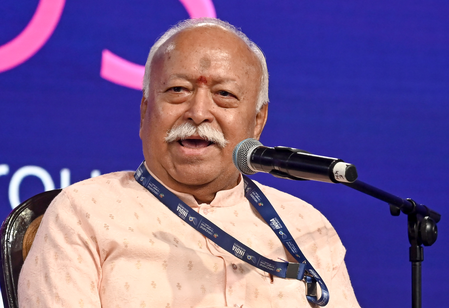
Yavatmal, Sep 29 (IANS) Rashtriya Swayamsevak Sangh (RSS) chief Mohan Bhagwat emphasised the need for inclusive economic and social development, saying true progress is meaningless if it fails to reach the person at the very end of the socio-economic ladder.
Speaking at an event organised by the Deendayal Seva Pratishthan to mark the birth anniversary of Pandit Deendayal Upadhyaya, Bhagwat reiterated the core philosophy of Integral Humanism (Ekatma Manav Darshan) and the concept of Antyodaya, which uplifts the last individual.
Bhagwat highlighted the stark economic contrast between different segments of society, asserting that while development is happening across the nation, narrowing the gap between the top and bottom tiers remains crucial.
“People may argue that in a vast country like India, everyone cannot reach the same level of growth simultaneously. That perspective is acceptable, but the gap between the highest and lowest levels of development must be kept to an absolute minimum,” Bhagwat observed.
He added that if national growth does not trickle down to marginalised communities, policymakers must rethink their development model and place the poorest individuals at the centre of planning.
Distinguishing between historical poverty and modern deprivation, the RSS chief noted that in ancient India, even economically underprivileged households possessed essential resources.
He outlined six fundamental necessities that every individual and family must have guaranteed access to: Food (adequate nutrition), Clothing, Shelter, Basic Education necessary for life, Healthcare and medical access, and Social Capability (the financial capacity to extend hospitality to guests and monks).
“In our country’s history, even the poor were not deprived of these six essentials. They had enough to sustain a dignity-filled life,” Bhagwat said, emphasising that modern economic models must strive to guarantee these minimum living standards for all citizens.
Addressing agricultural practices, Bhagwat remarked that farming should not be viewed merely as a commercial production system or business, but as a vital social responsibility dedicated to global well-being.
He cautioned against over-reliance on chemical farming, advocating for sustainable approaches aligned with natural harmony.
Concluding his address, Bhagwat framed national progress within a global perspective: “No one can be truly happy in this world as long as suffering exists around us. To make our country prosperous and happy, every single citizen within it must be empowered.”
–IANS
sj/dan