

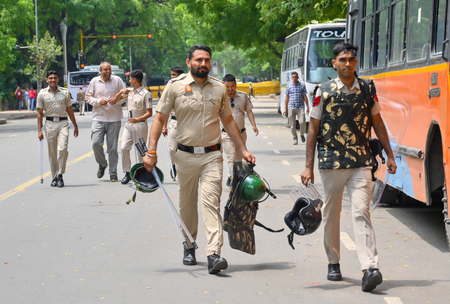
New Delhi, Aug 25 (IANS) Following the violence that broke out at Jantar Mantar on July 20 and the large-scale protests that followed, the Delhi Police has decided to overhaul and strengthen its intelligence-gathering mechanism to ensure better preparedness during major demonstrations and planned public gatherings.
According to sources, Delhi Police Commissioner Anurag Kumar has directed the Intelligence Wing and the Special Branch to gather and analyse at least 10 key pieces of information before any major or planned protest.
On July 20, a large number of protesters gathered in and around Jantar Mantar in Delhi. Around 30,000 people took to the streets and attempted to march toward Parliament demanding action against the paper leaks and other examination-related irregularities. As the situation deteriorated, clashes broke out between the police and the protesters. The police used force, leading to widespread criticism.
Following this incident, the police’s intelligence system was reviewed. Officials felt that they lacked adequate and accurate prior input regarding the number of protesters, their mobilisation, and the role of various organisations.
Therefore, according to sources, the Delhi Police Special Branch has been instructed to develop more detailed and usable intelligence inputs, rather than simply gathering information about the location of the protest and estimated crowd.
The police will now also profile the people participating in the protest. They will also identify how many people are coming from which state, how they are being mobilised, and the role of key leaders and organisers. Efforts will also be made to understand the protest agenda and their main demands in advance.
The police will also gather information about where the protesters are staying, their local contacts, and their local connections in Delhi.
Sources said that information will also be gathered about their connections with various organisations, potential sources of funding for the protest, and the logistical arrangements made for the crowd.
This means that the police will no longer focus solely on where and when the protest is taking place, but also on identifying who is organising the protest, who is mobilising the demonstrators, where they are coming from, their local contacts, and how the entire protest has been prepared.
The Police Commissioner has also issued strict instructions regarding the wireless communication system. To ensure rapid exchange of information between police personnel on the ground and senior officers during protests, the wireless network has been thoroughly inspected, and any deficiencies identified have been immediately addressed.
According to sources, the purpose of this entire exercise is not to prevent any protests, but to better assess the law and order situation during large public events.
Particular attention will be paid to protests that attract large numbers of people from outside Delhi or involve multiple organisations.
–IANS
sd/