
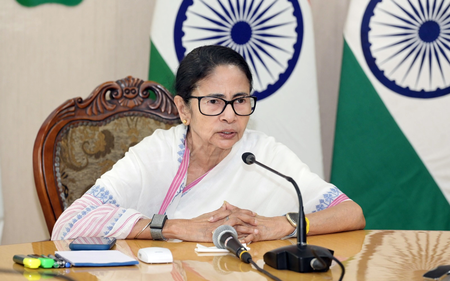
Kolkata, Feb 25 (IANS) West Bengal Chief Minister Mamata Banerjee on Wednesday expressed concern that around 1.20 crore voters’ names could be deleted from the electoral rolls in the state following the ongoing special intensive revision (SIR).
Addressing a gathering in her Assembly constituency of Bhabanipur in south Kolkata, the Chief Minister alleged that the Election Commission of India (ECI) is identifying a large number of voters under what it termed “logical discrepancy” cases.
“The Election Commission of India is planning to delete such a huge number of names after identifying them as logical discrepancy cases. The revision exercise is still on. I am in pain. First, over 58 lakh names were deleted in the draft voters’ list that was published in December last year. Then they started the process of deleting names after identifying them as logical discrepancy cases. I apprehend that a total of 1.20 crore voters’ names will be finally deleted at the end of the SIR. I fought up to the level of the Supreme Court in the matter. The fight is still on,” the Chief Minister said.
She alleged that names of genuine voters were being deleted across communities.
“My only prayer now is that the democratic rights of the people should remain protected. I am against the deletion of names. I pray for them whose names will be deleted. I heard that names of voters with valid identity documents are also being deleted,” she said.
Officials said that logical discrepancy cases refer to instances where irregularities were detected in family tree data during the process of “progeny mapping.”
As per the current schedule, the final electoral rolls in West Bengal are set to be published on February 28.
However, since judicial proceedings are underway regarding documents of over 50 lakh voters identified under logical discrepancy cases, supplementary electoral rolls may be published after the final list is released.
Speaking on the occasion, the Chief Minister also highlighted what she described as the tradition of communal harmony in the state.
“Since childhood, we are given lessons about all religions,” she said.
She described Bhabanipur as a “mini-India”, where people from different parts of the country live together in unity.
–IANS
src/pgh