

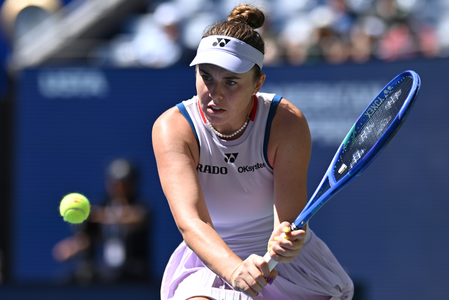
Beijing, Oct 4 (IANS) Linda Noskova and Mirra Andreeva kept their China Open campaigns on track on Sunday, advancing to the fourth round as the tournament continued to produce major upsets at the top of the draw. While top seed Elena Rybakina and second seed Aryna Sabalenka were eliminated within a day of each other, Noskova and Andreeva avoided the upheaval with commanding victories.
Fifth seed Noskova needed only 55 minutes to dispatch Viktorija Golubic 6-2, 6-1, while fourth seed Andreeva recovered from an early deficit before beating Polina Kudermetova 6-4, 6-1 in 68 minutes.
The two young Grand Slam champions took contrasting routes to victory. Noskova dictated the contest with aggressive first-strike tennis, while Andreeva had to absorb sustained pressure from an opponent willing to take the initiative.
Noskova’s serve provided the platform for her emphatic performance. The Wimbledon champion landed 77 per cent of her first serves and lost just five points behind that delivery throughout the match. She was briefly under pressure at the beginning of the second set when three consecutive unforced errors left her facing three break points, but she responded immediately.
Three unreturned serves and two winners helped Noskova escape the danger, and she went on to win five consecutive points to hold.
The 21-year-old also ensured Golubic could not settle into a rhythm by varying the way she constructed points. Along with powerful groundstrokes, Noskova repeatedly used drop shots and drive volleys, while her willingness to move forward added another dimension to her attack.
Her return game became increasingly adventurous in the second set, including an angled backhand volley winner after she charged towards the net.
Andreeva faced a markedly different challenge. Kudermetova generated far more attacking numbers from the baseline, striking 25 groundstroke winners compared with only three from Andreeva. The Uzbek also mixed power with touches around the court, particularly with her backhand, drop shots and net play.
Yet Andreeva’s ability to adjust ultimately proved decisive.
After falling 4-2 behind in the opening set, the French Open champion took control of the contest by winning 10 of the next 11 games. Her unforced errors dropped from 12 in the first set to six in the second, while she saved all five break points she faced in the final set.
Andreeva produced key points under pressure, including a backhand winner down the line and two aces when Kudermetova threatened to get back into the contest.
Kudermetova, meanwhile, struggled to maintain the level of her early attacking tennis and finished with 48 unforced errors.
Noskova will next meet 19th seed Ekaterina Alexandrova, who recovered from a set and a breakdown to eliminate 11th seed Diana Shnaider 3-6, 6-4, 6-3.
Alexandrova changed the rhythm of the contest with an unexpected angled-slice winner during the second set, breaking away from the baseline exchanges that had dominated the match. The 31-year-old went on to secure her third victory in four meetings with Shnaider and reached the last 16 at the WTA 1000 level or higher for the second time this season.
Her head-to-head record against Noskova stands at 1-1. Alexandrova won their hard-court meeting in Monterrey last year, while Noskova responded with a 6-1, 6-1 victory on clay in Stuttgart earlier this season.
Andreeva’s next opponent will be Daria Snigur, who produced one of the most emphatic victories of the round. The Ukrainian overwhelmed Taylah Preston 6-1, 6-0 in just 47 minutes, dropping only eight points in the second set.
The result marks Snigur’s first appearance in the fourth round of a WTA 1000 tournament. It also represents a dramatic turnaround from her opening matches in Beijing, where she was forced to recover from a set down against qualifier Katarzyna Kawa and 14th seed Jasmine Paolini.
With Rybakina and Sabalenka already gone, the path through the Beijing draw has opened considerably. Noskova and Andreeva have so far avoided the chaos, and will now look to carry that momentum into the last 16.
–IANS
vi/hs